The enterprise has become very good at finding places to use AI.
That sounds like progress. It is also becoming a problem.
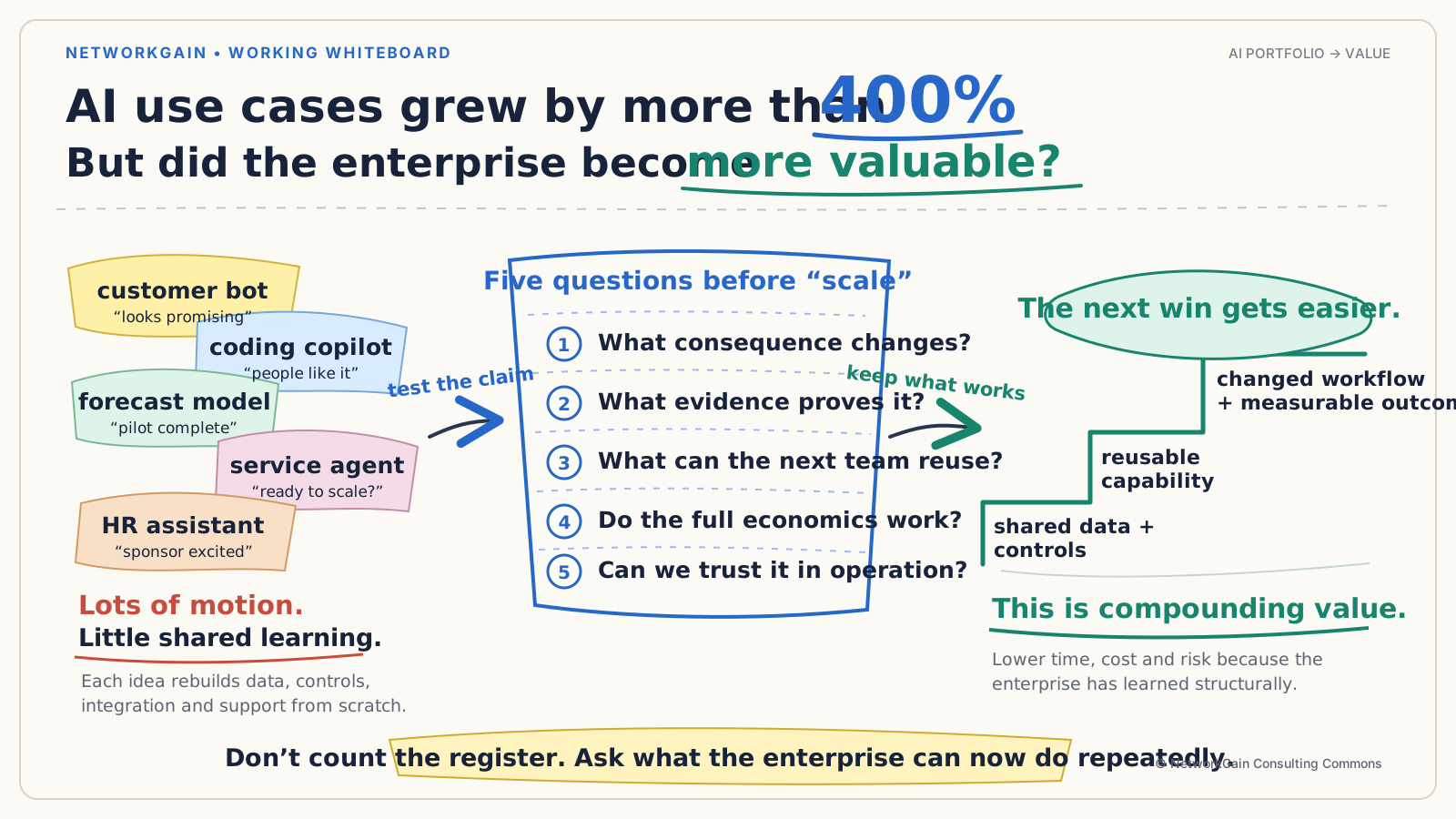
At its 2026 IT Symposium/Xpo, Gartner reported that the average organisation had increased its number of AI use cases by more than 400% in a single year. Yet Gartner also said that only one in five AI use cases was delivering a positive return. In a separate survey, just 13% of CIOs said their enterprise had realised significant or transformational value from AI.
These figures come from different Gartner studies and should not be read as one mathematical funnel. But together they expose an uncomfortable pattern:
AI activity is compounding faster than AI value.
The issue is not that enterprises are experimenting too much. Early exploration is necessary. The issue is that many organisations have industrialised the production of use cases without building an equally disciplined system for choosing, connecting, stopping and scaling them.
A crowded AI register can therefore create the appearance of momentum while hiding fragmented investment, duplicated capabilities and benefits that never reach the income statement, the customer or the frontline.
The next phase of enterprise AI will not be won by the company with the longest list of ideas. It will be won by the company that makes every successful implementation lower the cost, risk and time required for the next one.
The use-case count has become a comforting metric
Use cases are attractive because they are visible.
They can be named, counted and presented. A customer-service copilot. A contract summariser. A coding assistant. A forecasting model. An HR agent. An automated management report. Each entry makes the organisation appear more active and the AI programme appear more substantial.
But a use case is not a unit of value. It is a hypothesis about value.
It becomes valuable only when it changes an outcome that matters: revenue, margin, cost to serve, cycle time, quality, risk exposure, customer experience, employee capacity or the speed of a consequential decision. Until then, it is an option the enterprise has purchased—not a return it has earned.
The distinction matters because the cost of creating an AI prototype has fallen dramatically. A competent team can now produce a convincing demonstration in days. The demonstration may use realistic data, generate fluent answers and delight senior leaders. It may still fail in the operating environment.
The data may not be reliable enough. The workflow may cross systems the agent cannot access. Users may not trust the recommendation. Exceptions may require more human effort than the automation saves. Security review may arrive after design rather than before it. Token, platform and supervision costs may change the economics. No operating owner may be prepared to change the process around the tool.
None of these failures is visible in a use-case count.
This is why volume is so seductive. It measures what is easy to start instead of what is hard to finish.
The 400% increase is not necessarily bad news
There is a tempting but unhelpful conclusion: if many projects do not produce positive returns, enterprises should stop experimenting.
That would be the wrong response.
New general-purpose technologies do not arrive with a complete operating manual. Organisations have to discover where the technology fits, which jobs should change, how people respond and what the true economics look like. A portfolio of experiments creates learning and optionality. It helps teams develop AI fluency, exposes weak data and reveals processes that were poorly understood long before AI arrived.
Some benefits also appear before they can be cleanly attributed to enterprise earnings. McKinsey’s 2026 State of AI survey found that eight in ten respondents said AI improved their individual productivity, while about half said it helped them develop skills and make better decisions. Those are meaningful effects even when the finance function cannot yet isolate them in EBIT.
The use-case boom is therefore evidence of curiosity, access and falling barriers to invention. Enterprises should not suppress that energy.
They should stop confusing it with transformation.
Exploration is useful when it produces evidence. It becomes waste when every experiment is treated as a special case, every team rebuilds the same foundations and politically attractive pilots survive without proving an outcome.
The management question is no longer, “How do we generate more AI ideas?” Most organisations have more ideas than they can absorb.
It is, “How do we convert distributed experimentation into a smaller number of advantages that can compound?”
Why value gets lost between the pilot and the enterprise
The value gap rarely has one cause. It is created by several small separations.
The problem is separated from its owner
An AI team is asked to automate a task, but nobody owns the full business outcome. The model may reduce handling time while increasing review, escalation or rework elsewhere. Local productivity rises; end-to-end performance does not.
The benefit is separated from a baseline
The business case promises faster work or better decisions, but the organisation never establishes the current cost, quality, delay or error rate. After deployment, there is no credible counterfactual. Testimonials replace evidence.
The prototype is separated from the workflow
The pilot performs well in a demonstration environment. Production requires identity, permissions, data contracts, monitoring, exception handling, auditability and integration with the systems where work is actually completed. The model was the visible part; the operating system around it is the real investment.
Adoption is separated from redesign
People receive an assistant while their objectives, controls and processes remain unchanged. They may use the tool, but the organisation retains the old steps as a safety net. AI is added to the work rather than used to redesign it. Cost increases because both systems continue.
Technology cost is separated from business economics
Model charges are only one part of the bill. Retrieval, integration, evaluation, human review, security, observability, remediation and change all matter. A use case can be technically successful and economically unattractive at the volume required.
Risk is separated from value
Governance is either postponed until the end or applied as a generic approval layer. In the first case, risk appears late and stops scale. In the second, low-risk experiments carry the same burden as high-consequence decisions. Both approaches slow useful work without making the enterprise meaningfully safer.
Gartner’s latest warning makes this tension explicit. It reported on 9 November that 86% of CIOs see AI risk growing faster than AI value, and that organisations expect agentic deployment to move much faster than agentic governance capability.
This is not an argument for more control everywhere. It is an argument for control that travels with the work.
Stop managing projects. Start building value systems.
When every use case is managed independently, the portfolio grows by addition. One more idea requires one more data connection, evaluation method, approval path, integration and support burden.
Value compounds only when successful work creates assets that the next initiative can reuse.
Those assets may include trusted data products, common identity and permission patterns, model-routing services, evaluation suites, approved interaction designs, audit evidence, reusable agents, domain ontologies, cost controls and teams that know how to redesign a workflow rather than merely add a feature.
This changes the unit of management.
The enterprise should still examine individual opportunities, but it should fund and govern value systems: related groups of workflows anchored in a business outcome and supported by common capabilities.
A collection of contact-centre experiments, for example, might become a customer-resolution value system. The objective is not to deploy five separate assistants. It is to improve resolution, retention and cost to serve through a shared understanding of the customer, consistent permissions, reusable knowledge, measurable quality and an operating owner who can change the process.
One successful implementation then improves the next. Data becomes cleaner. Evaluation becomes faster. Controls become clearer. Users learn what to trust. Unit economics become visible. That is compounding value.
Without this reuse, 400% more use cases can simply mean 400% more fragmentation.
A practical discipline for the AI portfolio
Leaders do not need another ceremonial committee. They need a small number of hard questions applied consistently from idea to production.
1. What consequence will change?
Name the customer, financial, operational or risk outcome—not the AI feature. Identify the accountable business owner and establish the baseline before development begins.
“Deploy an agent” is an activity. “Reduce avoidable service rework without increasing customer harm” is an outcome.
2. What must the enterprise believe for this to work?
Make the assumptions visible. Data quality, user behaviour, model reliability, exception volume, integration effort and operating cost should be testable claims. A pilot should be designed to disprove weak assumptions early, not merely to demonstrate capability.
3. What will be reused?
Every initiative should identify the capability it consumes and the capability it leaves behind. If the next use case starts from zero, the portfolio is not learning structurally.
4. What is the fully loaded value equation?
Measure benefits against the full cost of operation: technology, human oversight, change, assurance, failures and ongoing improvement. Track value per completed business outcome, not prompts, users or tokens in isolation.
5. When will we stop?
Stopping rules are a sign of maturity, not pessimism. Gartner found that organisations producing stronger outcomes were more likely to establish explicit stopping rules at both pilot and production stages. An initiative should end when its core assumptions fail, when economics do not improve or when another capability can deliver the outcome more effectively.
6. What earns the right to scale?
A pilot should not scale because the demonstration was impressive or the sponsor is senior. It should scale because the outcome repeats, users adopt it, controls work, unit economics improve and the operating owner is ready to change the surrounding process.
These questions introduce useful friction. They slow the wrong momentum so the right momentum can accelerate.
The operating implication
The AI portfolio can no longer sit entirely inside technology, innovation or a centre of excellence.
Technology leaders remain essential because architecture, data, security, integration and operational reliability determine whether AI can function. But value also requires business ownership, financial attribution, workforce redesign and risk decisions. No single function can make those trade-offs alone.
The answer is not consensus on every decision. It is a clear decision system.
Business leaders should own the outcome and the process change. Technology should own the integrity and economics of the enabling capability. Finance should agree how value will be measured and attributed. Risk leaders should define proportionate boundaries. Frontline teams should shape how the work actually changes. A small portfolio authority should decide where to invest, where to reuse, where to stop and where evidence justifies scale.
This also changes the role of the AI centre of excellence. Its purpose should not be to accumulate projects. It should make the rest of the enterprise better at delivering trustworthy AI outcomes—through patterns, platforms, expertise, measurement and challenge.
Deloitte’s 2026 enterprise AI research found that only a quarter of respondents had moved at least 40% of their pilots into production. Gartner separately found that only 22% of organisations had successfully scaled AI across multiple business units. These findings reinforce the same point: the constraint is no longer access to ideas or models. It is the enterprise’s capacity to absorb change and repeat success.
The NetworkGain view
AI use cases are growing because intelligence has become easier to access. Value is not keeping pace because enterprises are still managing that intelligence through project-era structures.
The solution is not a bigger catalogue. It is a better system of consequence.
NetworkGain would ask leaders to reduce the portfolio to four connected views:
- Outcomes: Which few business consequences matter enough to organise around?
- Capabilities: Which reusable data, engineering, governance and workflow assets make repeated delivery possible?
- Evidence: What changed, compared with what baseline, at what fully loaded cost and confidence?
- Decisions: What should stop, continue, combine or scale—and who is accountable for that choice?
This is where an independent advisory and execution partner can help. Not by producing another list of AI possibilities, but by connecting strategy, architecture, operating change, assurance and economics around a measurable outcome. NetworkGain and the EnWithAI cohort can help organisations frame the portfolio, test value hypotheses, design reusable delivery patterns and establish the traceability required to scale AI without losing control.
The objective should be to leave the client with more than a working use case. It should leave behind a stronger capability to make the next decision.
What to do next
Start with the current register of AI initiatives—but do not count it.
Cluster it.
Group the initiatives by business outcome, shared data, common workflow and reusable capability. Identify duplicated foundations and benefits with no baseline. Find projects that have remained “strategic” without earning evidence. Separate tools that make individuals faster from changes that improve the end-to-end enterprise.
Then make four decisions:
- Stop the work whose assumptions no longer hold.
- Combine initiatives that depend on the same capability or outcome.
- Scale the few interventions that have repeated evidence and sound economics.
- Fund the reusable foundations that reduce the cost and risk of everything that follows.
The 400% rise in use cases shows that enterprises are not short of imagination.
The next test is whether they can become equally good at institutional learning, disciplined stopping and repeatable value.
The enterprise does not need more places to use AI. It needs more evidence that AI has changed something worth keeping.