India’s manufacturing competitiveness will not be built only through larger factories, newer machines, or broader technology adoption.
It will be built when thousands of everyday production problems are converted into reusable knowledge.
For MSMEs, the constraint is often not ambition. It is access: access to structured problem solving, experienced manufacturing expertise, reliable documentation, root-cause methods, practical automation pathways, and continuous improvement discipline.
Generative AI changes the economics of that access.
But only if it is organized around real problems, expert validation, measured outcomes, and reusable assets.
That is the shift industry forums, task forces, institutions, and MSME-support programs now have an opportunity to make. The next phase of Production Excellence and Industry 4.0 should not be limited to awareness sessions, policy notes, vendor showcases, or adoption checklists.
Those are useful.
They are not enough.
The more important question is:
Can every solved MSME problem become a permanent contribution to India’s manufacturing intelligence?
The Real Issue Is Not Software
Most MSMEs do not suffer from a lack of software.
They suffer from recurring operating constraints that are specific, practical, and financially material:
- Rejections that return every month
- Machine downtime that everyone has learned to tolerate
- Inventory that traps working capital
- SOPs that exist informally in the memory of a supervisor
- Energy leakage that is visible only in the bill
- Maintenance practices that depend on habit rather than evidence
- Skill gaps that slow quality, safety, and throughput
- Dashboards that report activity but do not improve decisions
- Automation ideas that remain unstructured because the starting problem is unclear
Individually, each looks like a local plant issue.
Systemically, they represent a national knowledge gap.
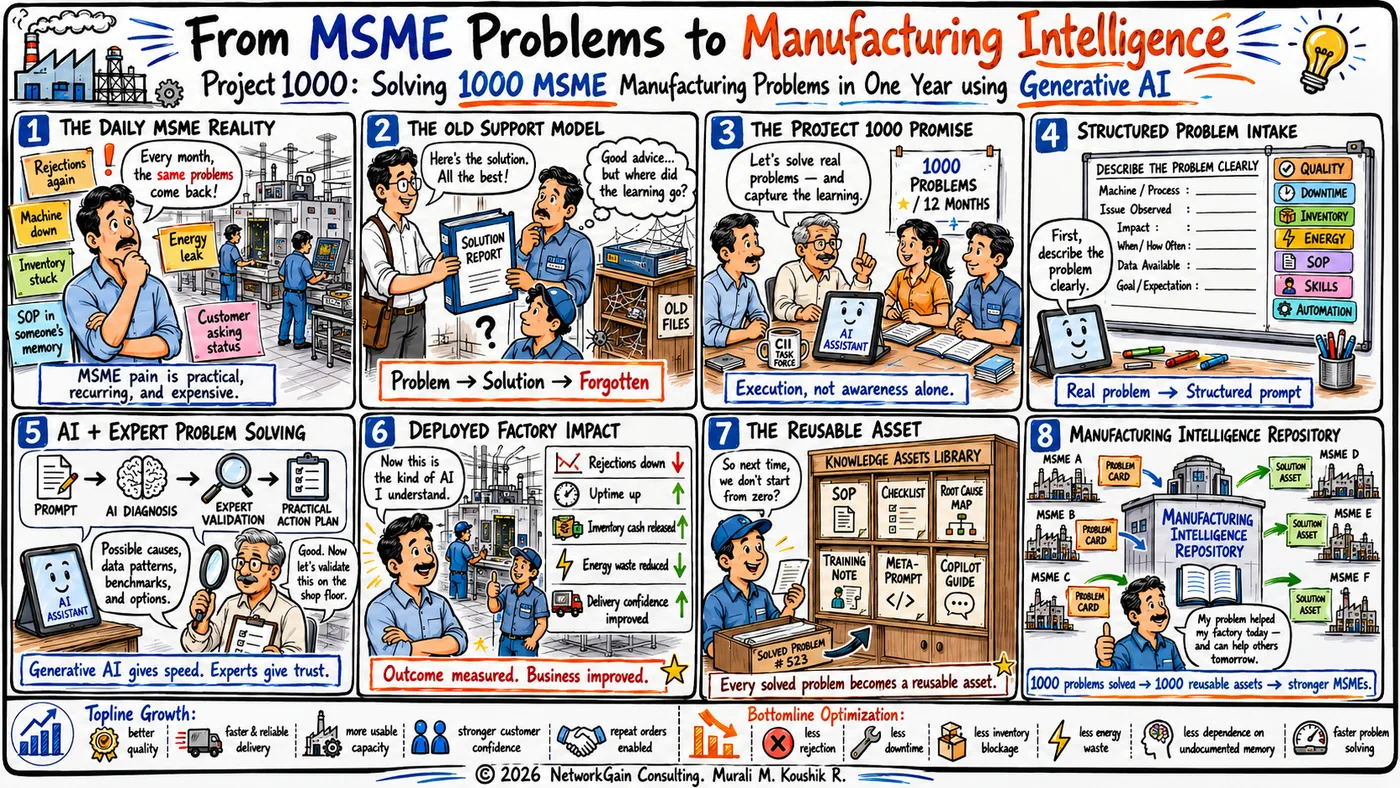
The traditional support model treats each problem as a project. An expert visits, diagnoses, recommends, documents, and exits. The manufacturer may receive relief, but the learning often stays with the expert or disappears into a file.
The enterprise improves for a moment.
The ecosystem does not become smarter.
The better operating frame is different:
Every solved problem should leave behind a reusable knowledge asset.
Why MSME Initiatives Often Lose Operating Force
MSME programs usually begin with the right intent. They want to improve productivity, quality, competitiveness, technology adoption, and resilience.
Yet many programs drift toward activity rather than capability.
Conferences are conducted. Panels are convened. Frameworks are presented. Vendors demonstrate tools. Policy themes are discussed. Surveys are circulated. Adoption maturity is assessed.
These actions have value. They build awareness and direction.
But a manufacturer does not become more competitive because it attended a session on Industry 4.0.
It becomes more competitive when rejections reduce, uptime improves, working capital is released, safety improves, operators learn faster, and decisions move closer to the point of work.
That is why any serious MSME manufacturing initiative must be designed around a sharper unit of progress:
the solved problem.
If the problem is real, the solution is validated, the outcome is measured, and the learning is converted into a reusable asset, the program creates durable capability.
If the problem is only discussed, the ecosystem remains dependent on the next event, the next consultant, or the next scheme.
Project 1000 As An Operating Idea
Project 1000 matters because it begins with a simple and practical ambition:
Solve 1000 real MSME manufacturing problems in 12 months.
The number is useful because it forces execution discipline. It prevents the initiative from remaining abstract. It makes the work visible, measurable, and cumulative.
But the deeper value is not the count.
The deeper value is the conversion path:
Problem -> structured prompt -> solution -> expert validation -> outcome capture -> reusable asset -> manufacturing copilot -> manufacturing intelligence repository.
This changes the purpose of problem solving.
The goal is not only to help one plant resolve one issue. The goal is to ensure that each solved problem increases the problem-solving capacity of many other manufacturers.
That is the difference between technology promotion and capability creation.
The Real Asset Is Structured Intellectual Capital
The real asset in MSME manufacturing AI is not a chatbot.
The real asset is structured manufacturing intelligence.
A well-designed initiative should produce four levels of reusable assets.
1. Practical Shop-Floor Assets
These are the assets supervisors, operators, quality teams, maintenance teams, and owners can use immediately:
- SOPs
- Checklists
- Corrective action guides
- Training modules
- Maintenance schedules
- Safety checklists
- Quality inspection templates
- Simple dashboards
- Implementation roadmaps
These assets reduce dependency on memory and informal knowledge.
2. Reusable Problem-Solving Assets
These are the reusable patterns behind better decisions:
- Root-cause libraries
- Defect reduction models
- Downtime analysis frameworks
- Inventory optimization patterns
- Energy audit prompts
- Value stream mapping templates
- OEE improvement frameworks
- Working capital release models
These assets help MSMEs solve similar problems faster and with more structure.
3. Plant-Level Intelligence Assets
These are the assets that move from documentation to assisted execution:
- Manufacturing copilots
- AI agents
- Knowledge bases
- Knowledge graphs
- KPI assistants
- Workflow assistants
- Decision-support dashboards
These assets help teams act with better context at the point of work.
4. Ecosystem-Level Infrastructure
This is the long-term asset:
a Manufacturing Intelligence Repository.
Such a repository would capture what has been learned across plants, sectors, processes, equipment types, problem categories, and solution patterns.
It becomes a knowledge commons for manufacturing improvement.
Every solved problem becomes intellectual capital.
Every meta-prompt becomes reusable industrial capability.
Every MSME becomes both contributor and beneficiary.
The Task Force Opportunity
Industry task forces have an important role in shaping policy, direction, and priorities.
But for MSME manufacturing, their deeper contribution can be more action-oriented.
A task force focused on Production Excellence and Industry 4.0 can become an execution architecture for measurable improvement. It can create a disciplined mechanism through which:
- MSMEs bring real operating problems
- Experts validate practical solutions
- Institutions contribute domain knowledge and field access
- Students and volunteers learn through applied problem solving
- Technology partners contribute tools without making the tool the center
- Outcomes are measured transparently
- Reusable knowledge assets are contributed back to the ecosystem
This is not a replacement for policy thinking.
It is the field execution layer that makes policy meaningful.
The work plan for any such initiative should therefore include more than themes, events, and recommendations. It should include a problem intake mechanism, a taxonomy, expert review protocols, measurable KPIs, knowledge-asset standards, and a repository model.
That is where thought leadership becomes operating leadership.
What Should Be Measured
An MSME manufacturing initiative should be measured by outcomes, not by activity.
The useful scorecard is practical:
- Problems solved
- Companies assisted
- Savings generated
- Downtime reduced
- Rejections reduced
- Inventory released
- Energy saved
- SOPs generated
- Training modules created
- Automation opportunities identified
- Meta-prompts validated
- Copilots prototyped
- Experts onboarded
- Students and volunteers trained
- Reusable assets added to the repository
The question should not be, “How many sessions were conducted?”
The question should be, “What operating condition improved, and what repeatable knowledge was created?”
That one shift changes the seriousness of the program.
The Manufacturing Meta-Prompt Layer
Generative AI becomes useful in manufacturing when it is given disciplined context.
Generic prompting will not create reliable industrial outcomes. Manufacturing problems need domain structure: machine, material, method, measurement, workforce, quality history, maintenance records, constraints, cost, safety, compliance, and operating reality.
That is why a manufacturing meta-prompt library is central to this model.
Such a library can cover areas such as:
- Quality excellence and root-cause analysis
- TPM and maintenance
- Lean manufacturing
- Inventory and supply chain
- Energy management
- Documentation and compliance
- Workforce development
- Manufacturing engineering
- Automation and digitalization
- Generative AI for MSMEs
The purpose is not to make AI sound intelligent.
The purpose is to make problem solving more structured, repeatable, and accessible.
When an MSME reports high CNC rejection, chronic downtime, spare parts pressure, process variation, or trapped inventory, the system should not begin with a blank screen. It should begin with a domain-aware problem pathway.
That pathway can generate the first structured response. Experts can validate it. The plant can deploy it. Outcomes can be captured. The learning can improve the next response.
This is how a program learns.
Where Murali And NetworkGain Can Contribute
The contribution needed in such initiatives is not merely commentary on Industry 4.0.
It is execution design.
Murali brings manufacturing and technology depth: the ability to understand plant realities, production constraints, process discipline, and the practical distance between a recommendation and a working improvement.
NetworkGain brings the operating lens: business-technology alignment, AI adoption discipline, governance, execution architecture, and the ability to convert ideas into repeatable systems.
Together, this perspective can help shape the practical backbone of an MSME manufacturing intelligence initiative:
- The problem taxonomy
- The meta-prompt library
- The expert validation model
- The outcome dashboard
- The reusable asset standards
- The manufacturing intelligence repository
- The operating rhythm for scaling from pilots to repeatable impact
That is the kind of contribution industry platforms now need.
Not another layer of discussion.
A mechanism that helps MSMEs move from problem to outcome, and from outcome to shared intelligence.
The NetworkGain View
NetworkGain’s view is straightforward.
AI becomes useful only when it is anchored in the way work is actually done.
In manufacturing, this means AI must sit inside problem solving, not outside it.
The next leap in MSME competitiveness will not come from treating AI as a novelty or Industry 4.0 as a branding exercise. It will come from converting recurring operational problems into reusable knowledge assets that can scale across the ecosystem.
Project 1000 is powerful because it reframes MSME assistance.
It says the goal is not only to solve a manufacturer’s problem today.
The goal is to make every solved problem increase the problem-solving capacity of the entire ecosystem tomorrow.
That is a profound shift.
India does not need MSMEs to become passive consumers of AI.
It needs them to become contributors to a shared manufacturing intelligence network.
The future of manufacturing support is not awareness alone.
It is measured improvement, captured learning, and reusable intelligence.
That is how everyday MSME problems become national manufacturing capability.