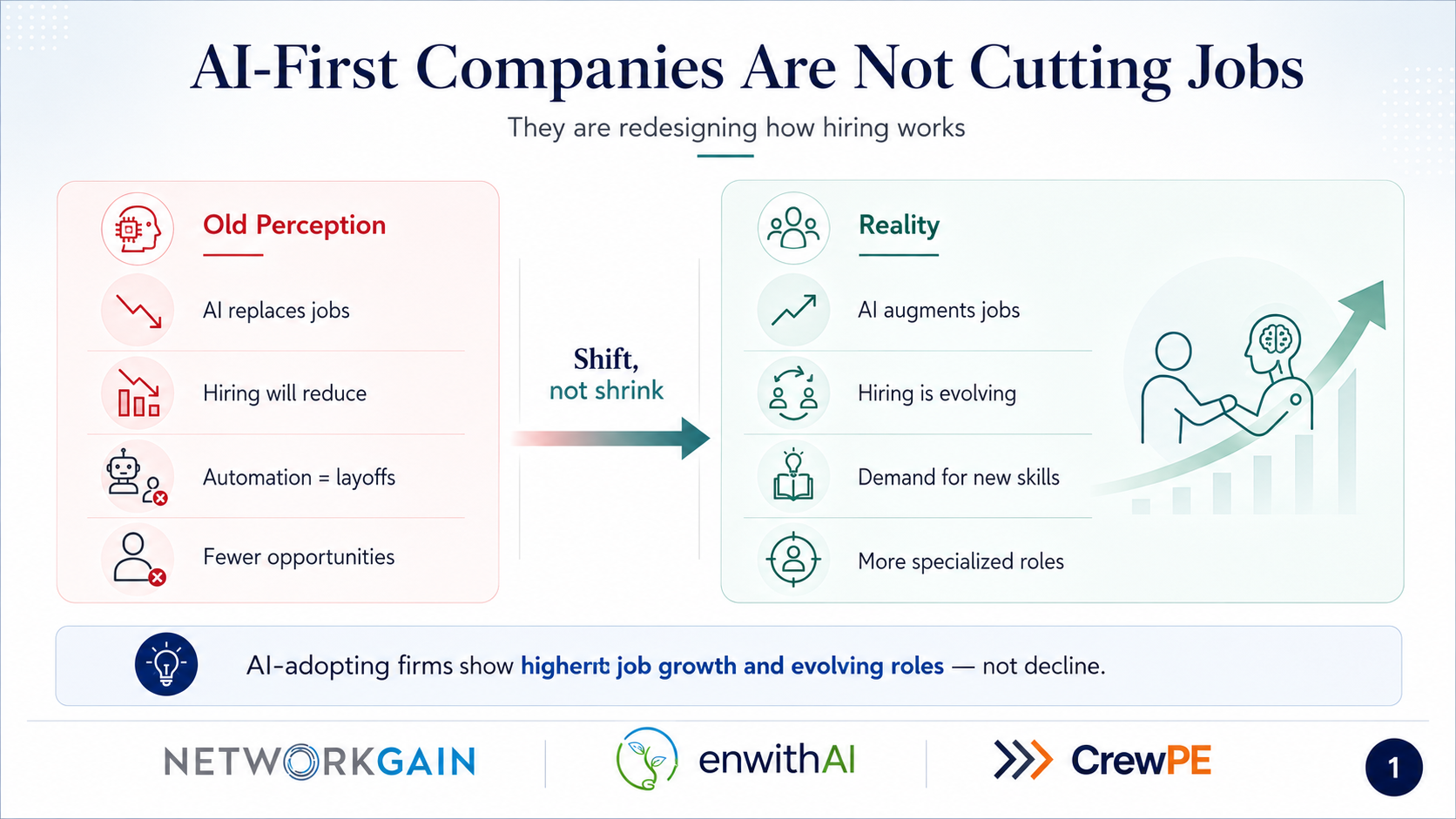
The prevailing narrative says AI will reduce jobs at scale.
That narrative is too simple.
The more useful signal from AI-adopting enterprises is not broad workforce disappearance. It is workforce restructuring. Roles are being redesigned. Skills are being recombined. Hiring demand is moving toward more specialized, AI-augmented, domain-aware work.
AI-first companies are not merely asking, “How many people can this tool replace?”
The stronger companies are asking a different question:
How should work, capability, and hiring be redesigned when AI becomes part of the operating model?
That distinction matters.
AI does not determine hiring outcomes by itself.
Structural readiness does.
The Data Signal Is Not Simple Job Reduction
Recent labor-market analyses, company disclosures, and workforce signals point toward a more nuanced pattern than simple job loss.
AI-adopting firms are not uniformly shrinking. In many cases, they are maintaining or increasing hiring in AI-aligned areas while reducing or reshaping work in legacy execution layers.
The pattern is visible in three ways:
- AI-adopting firms continue to post roles, especially where AI capability connects to product, data, cloud, security, operations, and engineering.
- Leading AI-driven companies are reallocating internal capacity toward AI, platform, and infrastructure work rather than treating AI as a clean headcount-reduction lever.
- Entry-level hiring in some AI-exposed domains is becoming more selective, while demand grows for mid-level and senior talent that can combine domain judgment, data fluency, and AI-enabled execution.
This is not a contradiction.
It is a structural signal.
AI is reducing some forms of routine execution while increasing demand for people who can define problems, interpret context, orchestrate systems, govern outcomes, and turn AI capability into operational value.
The Real Shift Is From Hiring More to Hiring Differently
AI is not eliminating work.
It is redistributing work across higher-value layers.
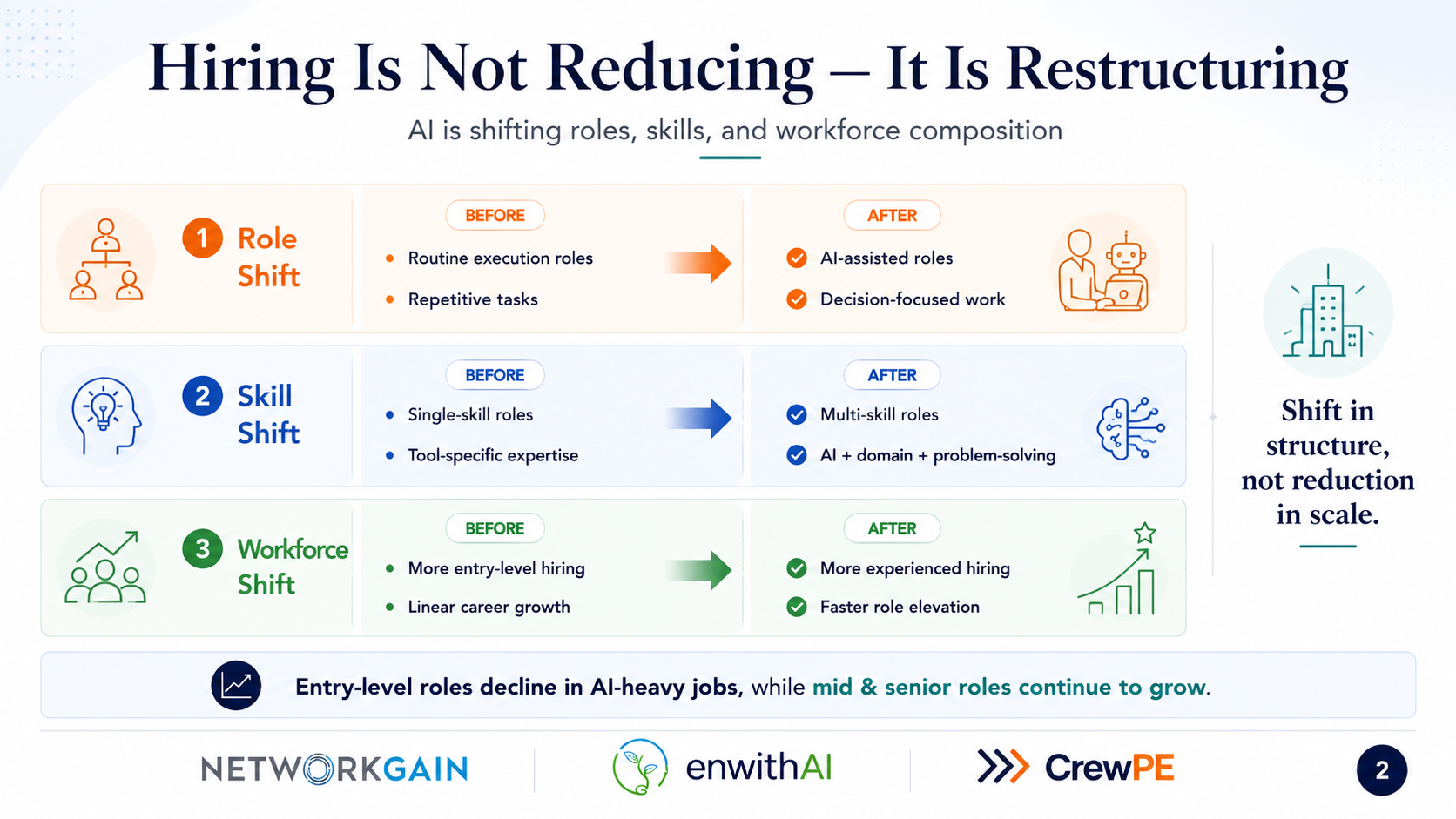
Routine execution is being compressed. Decision-making, orchestration, integration, validation, and governance are expanding. Roles that were once task-defined are becoming capability-defined.
This produces a new workforce shape:
- Fewer purely junior, task-oriented roles
- More AI-assisted roles that combine human judgment with intelligent tools
- More hybrid roles across business, data, engineering, operations, and governance
- Higher expectations for professionals who can move between domain context and technical execution
- Faster elevation for employees who can use AI to amplify judgment rather than only automate tasks
Hiring is not reducing in a straight line.
It is restructuring around capability.
Why the Contradiction Exists
Organizations are seeing different outcomes from the same technology.
Some see fragmented pilots, uncertain returns, confused hiring signals, and anxious workforce narratives.
Others scale use cases, expand capability, and increase targeted hiring.
The differentiator is not access to AI tools.
It is whether the enterprise is structurally prepared to absorb and operationalize AI.
In organizations without structural readiness, AI creates noise. Leaders launch pilots without redesigning work. Hiring managers add AI requirements to existing roles without changing the operating model. Teams automate fragments of workflow without rethinking accountability, governance, data, and measurement.
In organizations with structural readiness, AI becomes part of a coherent capability system. The company knows which work should be automated, which decisions require human judgment, which roles need to evolve, and which new capabilities must be built.
That is why two organizations can adopt similar tools and produce different hiring outcomes.
The tool is not the strategy.
The operating model is.
The Missing Layer: Structural Readiness
AI success is not a tooling problem.
It is an execution-system problem.
Enterprises that fail to scale AI typically show familiar weaknesses:
- Strategy disconnected from execution
- Data fragmented across systems and teams
- Architecture not designed for modular AI integration
- Governance and observability too weak for enterprise-scale deployment
- Hiring plans disconnected from operating-model change
- Workforce narratives focused on replacement rather than capability redesign
These gaps directly affect hiring.
Roles are created without clear value alignment. Hiring becomes reactive rather than strategic. AI investments do not translate into sustained capability. Leaders ask for “AI talent” without defining where that talent fits into the enterprise system.
Enterprises that succeed treat workforce redesign as part of AI adoption, not as a downstream HR response.
Integration Is the Multiplier
AI delivers value when four disciplines operate as a coordinated system:
Strategy. Intelligence. Engineering. Operations.
When these disciplines remain fragmented, experiments do not scale. Hiring demand becomes inconsistent. Value realization is delayed. The organization hires for tools rather than for capabilities.
When these disciplines are integrated, the pattern changes.
Strategy defines where AI should matter. Intelligence helps prioritize and measure decisions. Engineering turns intent into reliable systems. Operations embeds AI into real workflows and feedback loops.
Hiring then becomes more precise.
The enterprise no longer asks for generic AI skills. It designs roles around the capabilities required to operate AI at scale.
The Three-Layer Execution Model Behind Scalable AI
In practice, this integration resolves into three non-optional capability layers.
1. Strategy and Operating Clarity
This is the NetworkGain Consulting lens.
The enterprise must define which problems matter, where AI creates real business advantage, and how hiring connects to long-term capability.
This layer aligns AI initiatives with enterprise strategy, architecture, governance, and operating rhythm.
Without it, AI remains experimentation without direction, and hiring becomes misaligned.
2. Intelligence and Decision Layer
This is the EnWithAI lens.
The enterprise needs data-driven prioritization of AI use cases. AI must enter decision flows, not sit as an isolated tool. The organization needs a unified intelligence layer across systems, functions, and workflows.
Without it, AI generates activity without measurable value, and hiring lacks focus.
3. Engineering and Execution Discipline
This is the CrewPE lens.
The enterprise must convert strategy and intelligence into scalable, production-ready systems. That requires modularity, traceability, reuse, validation, and workflow-level reliability.
Without this layer, AI remains at prototype stage, and hiring does not translate into capability.
Together, these layers form an execution system:
- Strategy defines direction.
- Intelligence enables decisions.
- Engineering delivers outcomes.

Why AI-First Companies Are Actually Hiring More
The original question becomes clearer through this lens.
AI-first companies are not hiring more because AI alone creates jobs.
They are hiring more because they are building the surrounding system required to convert AI into business value.
They need people who can:
- Redesign workflows around AI-assisted execution
- Build and govern data pipelines
- Integrate AI into products, platforms, and operating processes
- Manage security, risk, compliance, and human review
- Translate business problems into AI-enabled systems
- Measure adoption, productivity, quality, and customer impact
- Improve the operating model as AI capability changes
This is why hiring demand often shifts upward in complexity.
Entry-level task execution may face pressure in AI-heavy domains. But mid-level and senior roles that combine judgment, domain expertise, systems thinking, and AI capability continue to grow in importance.
The workforce is not simply shrinking.
It is being reweighted toward higher-context work.
The Leadership Implication
The next phase of AI will not be defined by access.
It will be defined by preparedness.
Leaders should ask:
- Are we structurally aligned to convert AI into business value?
- Is our hiring model connected to capability, or reacting to tools?
- Do our data and systems support integrated decision-making?
- Can we execute at scale, not just experiment?
- Have we redesigned workflows before asking people to become “AI-ready”?
- Are we measuring outcomes, not activity?
- Do we know which roles should be elevated, redesigned, automated, or newly created?
These are not HR questions alone.
They are enterprise operating-model questions.
The NetworkGain View
NetworkGain’s view is straightforward.
AI is not a job reduction mechanism.
It is a structural reconfiguration force.
Hiring is not shrinking in a simple way. It is being redesigned.
Roles are not disappearing in a simple way. Many are being elevated, combined, or redirected.
Demand is not declining in a simple way. It is moving toward organizations and people that can turn AI into repeatable enterprise capability.
The real divide is not between companies that use AI and companies that do not.
It is between companies that are structurally ready to use AI and those that are not.
AI does not determine hiring outcomes.
Structural readiness does.