There is a familiar scene inside almost every technology or consulting firm.
It is late. A young analyst is still at work. One screen holds a spreadsheet, another a presentation, and a third a trail of messages from people who know different pieces of the answer. The analyst is gathering evidence, reconciling contradictions, rewriting a recommendation and learning—slowly—how an experienced professional thinks.
For generations, this was how the pyramid worked. Clients paid for the output. Firms used the work to develop their people. Juniors produced the analysis, managers shaped it, partners carried the judgment and the institution stood behind the advice.
Now imagine that much of the first draft arrives in minutes.
The research is assembled. The code is written. The incident is investigated. The options are compared. The presentation is coherent. The model has read more of the client’s material than any individual consultant could. It is not always right. But it is fast, improving and increasingly able to act.
The question is no longer whether AI will enter professional work. It is already inside the delivery model.
The harder question is the one few firms want to ask:
Who will be next to fall into its kill zone?
The phrase is deliberately uncomfortable. It should not be read as a celebration of companies failing or people losing work. It is a way to identify the economic space in which a previously valuable product or service becomes difficult to defend because a powerful platform can absorb it.
Our thesis is this:
The AI kill zone is not an industry. It is undifferentiated work.
The next firms under pressure will not necessarily be the least intelligent or the least respected. They will be the firms whose value can be reduced to codified knowledge, repeatable production and coordination—without distinctive context, judgment, trust or accountability.
The frontier is moving closer to the client
Recent developments deserve to be read together.
The Financial Times reported on 23 October that Anthropic and private-equity firm Hg had agreed to back an independent European AI consultancy. According to the report, the planned company would place consultants and engineers inside businesses to develop AI products and support implementation. Anthropic and Hg declined to comment, so the proposed venture should be treated as reported rather than completed fact.
Even with that caveat, the direction is clear. Anthropic has already announced a $100 million programme to train 10,000 Frontier Deployed Engineers by the end of 2027, beginning with people from Accenture, Bain, Capgemini, Deloitte, McKinsey and major enterprises. The stated ambition is not simply to teach prompt writing. It is to develop people who can take a use case through requirements, security review, production and adoption.
OpenAI is moving along a parallel path. Its expanded ServiceNow partnership brings models and agents into application development, IT-request resolution, incident work and cybersecurity. The announced direction includes an Autonomous Engineer and a Codex integration for application development and modernisation. Earlier, OpenAI formed Frontier Alliances with BCG, McKinsey, Accenture and Capgemini to build and operate AI coworkers across enterprises.
The frontier labs are therefore not only selling intelligence. They are shaping the implementation method, training the delivery workforce, entering the workflow, building the orchestration layer and getting closer to the business outcome.
That does not make the large consultancies obsolete. In fact, the labs are relying on them for industry knowledge, integration, change and scale. But it creates a strategic tension: today’s partner may also be absorbing tomorrow’s margin pool.
This is not unusual. Powerful platforms often expand into the valuable layers beside them. What makes this moment different is the speed at which intelligence can move across those layers.
This is not replacement. It is absorption.
The popular debate is framed too crudely: will AI replace consultants, developers or IT professionals?
Whole occupations rarely disappear in one clean movement. Their work is decomposed. Some tasks become cheap. Some roles become smaller. Some services become features. Some teams produce far more with fewer people. The surviving work is reorganised around what the technology still cannot reliably own.
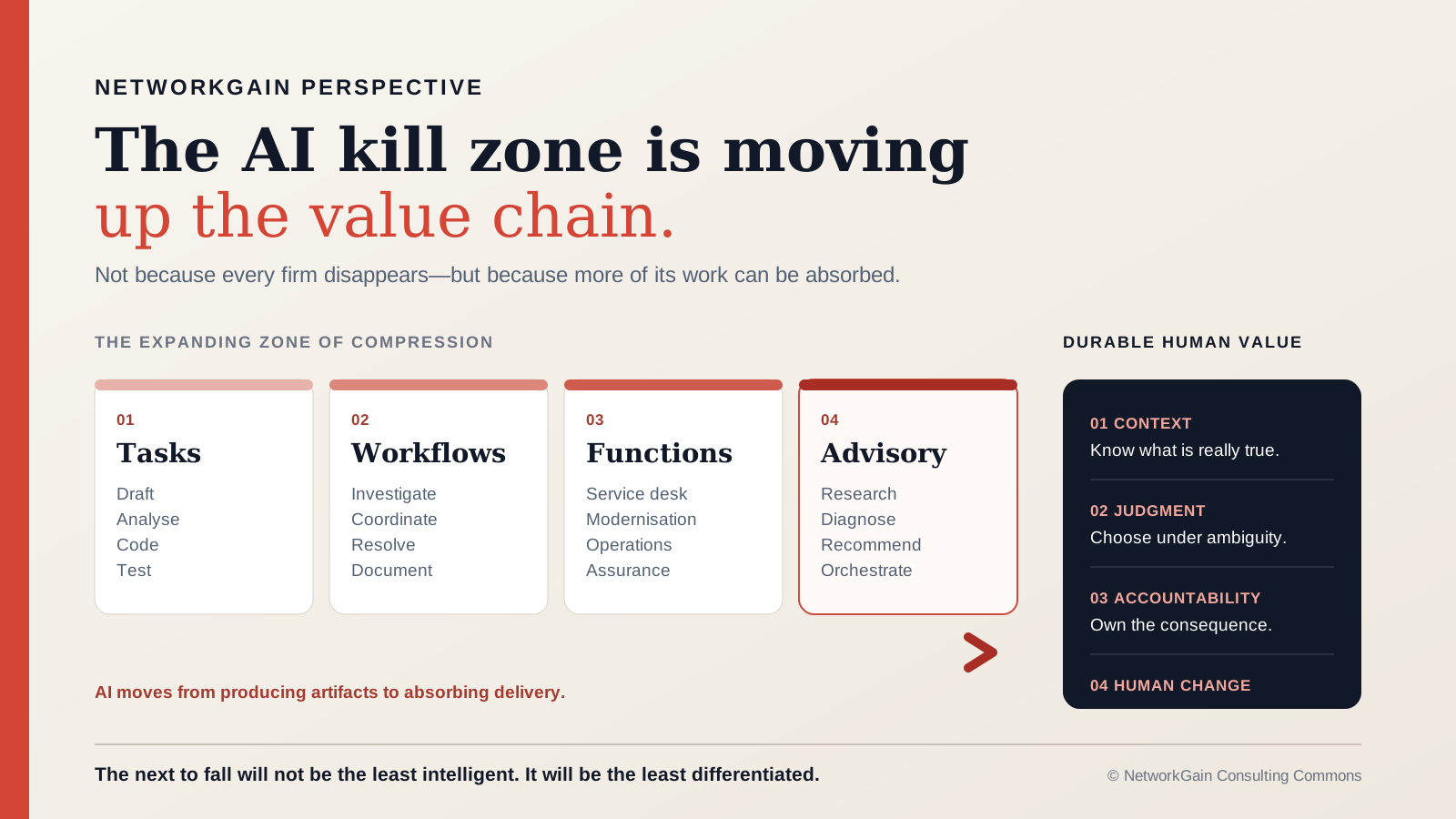
AI is moving through four levels of absorption.
First, it absorbed tasks: drafting, summarising, translating, researching, coding and testing.
Then it began absorbing workflows: investigating an incident, preparing a migration, resolving a service request, producing a management pack or carrying a software change from requirement to review.
It is now entering functions: service operations, application modernisation, security remediation, customer support and parts of finance, HR and procurement.
The next frontier is advisory and coordination: reading the organisation, diagnosing friction, comparing choices, recommending action and monitoring whether the decision was carried out.
An OpenAI essay on the future of the firm makes the ambition unusually explicit. Its authors imagine AI becoming a cheap, persistent consultancy that can parse an organisation’s communications and documents, surface problems and advise executives. The essay is presented as the authors’ view rather than an official OpenAI position, but it reveals how naturally the technology’s trajectory points toward work once reserved for professional intermediaries.
The real threat is therefore not that a chatbot produces a better presentation.
It is that the platform can increasingly travel from question to verified action, leaving fewer billable steps in between.
Who enters the kill zone first?
No serious analysis should declare an entire sector doomed. IT services and consulting contain work with very different economics, risks and requirements. But several business models are already exposed.
Staff augmentation without distinctive expertise
The model is simple: supply more people for more hours. It works when output scales with headcount and clients cannot easily obtain the capability elsewhere.
Agents weaken both assumptions. A small team with strong domain knowledge and an effective engineering harness can produce what once required a much larger bench. Clients will still need people, but they will challenge the relationship between team size, elapsed time and price.
The provider that sells capacity without improving the client’s capability will feel the pressure first.
Application maintenance built on repetitive effort
Large pools of work exist around code comprehension, routine changes, testing, documentation, ticket resolution and legacy modernisation. These activities do not vanish, but their labour content can fall sharply when agents can explore repositories, propose changes, run checks and preserve traceability.
A maintenance contract priced around the volume of manual effort becomes vulnerable even if the underlying application remains mission-critical.
Configuration and integration that never becomes intellectual property
Traditional systems integration converts knowledge of a vendor’s platform into implementation revenue. As software vendors embed agents, natural-language configuration and autonomous engineering into their products, some of that knowledge becomes part of the platform.
The integrator remains valuable where systems, data, policy and organisational realities collide. It becomes interchangeable where it repeatedly performs a pattern the platform can learn.
Research, benchmarking and presentation as a product
Clients have paid for access to organised information because finding, synthesising and communicating it took scarce professional time. AI makes competent synthesis abundant.
The generic market scan, benchmark summary, maturity assessment and polished deck are moving toward zero as standalone sources of differentiation. What remains valuable is the evidence others cannot access, the interpretation others cannot make, and the decision someone is prepared to stand behind.
The first line of IT and business operations
Service desks, reporting teams and operational coordination centres often exist because knowledge is fragmented and workflows cross systems. Agents connected to enterprise context can diagnose common issues, take permitted action and escalate exceptions.
The enduring function will be smaller and more capable: designing controls, resolving novel failures, improving the system and taking responsibility when automation meets reality.
These are not predictions of disappearance. They are warnings about compression. Revenue may persist while headcount intensity, pricing logic and competitive advantage change underneath it.
The quiet casualty may be the career ladder
There is a human question beneath the market analysis.
If AI performs the work through which juniors once learned, how will they become senior?
The apprenticeship model was imperfect. Young professionals spent too many nights formatting slides, reconciling spreadsheets and repeating work that added little human value. Few will mourn the drudgery itself.
But the drudgery carried hidden lessons. It exposed people to the texture of evidence. They saw how clean recommendations emerge from untidy facts. They learned which inconsistency matters, when a client is avoiding the real issue, how a system fails in production and why an apparently obvious answer cannot survive the organisation.
Remove the task without redesigning the learning, and the firm may create a generation that can supervise an output but has never developed the judgment to challenge it.
This is the strategic contradiction for professional services. AI can collapse the bottom of the pyramid at the same time that the firm needs more people capable of operating at its top.
The answer is not to preserve low-value work for training. It is to make apprenticeship deliberate. Juniors need earlier exposure to live decisions, simulated cases, exception handling, client conversations, model critique and accountable delivery. They should use agents, but they must also learn to recognise when the agent is fluent and wrong.
Human development can no longer be a by-product of billable labour. It has to become an engineered capability.
What remains outside the kill zone
No position is permanently safe. But some forms of value are harder to absorb.
Context that cannot be scraped
Every enterprise has an unofficial operating system: the history behind a decision, the customer promise no contract fully captures, the dependency no architecture diagram shows, the risk appetite leaders express differently in public and in private.
Models can process documented context. Trusted advisors help discover the context the organisation has never made explicit.
Judgment under genuine ambiguity
Many decisions do not have a provably correct answer. They require a choice among imperfect options, made before all evidence is available. Judgment is not only pattern recognition. It is knowing what matters here, now, for these people—and what consequence the organisation can carry.
Accountability for the outcome
A deliverable can be automated. Accountability cannot be delegated so easily.
The client still needs to know who will stand behind the recommendation, return when it fails, explain the trade-off to the board and remain present through the difficult part of change. Firms that sell artifacts are exposed. Firms that own consequences have a stronger claim to value.
Trust across contested boundaries
Transformation is rarely blocked by the absence of an answer. It is blocked because functions disagree, incentives conflict, data is politically sensitive or leaders do not believe the same story.
AI can reveal the disagreement. A trusted human institution must often help people move through it.
The ability to change the organisation
Implementation is not the final technical step after strategy. It is the social act of changing how decisions, authority, work and reward fit together. The firms that can connect technology to behaviour, governance and measurable outcomes will remain relevant even as the mechanics of delivery become cheaper.
The durable edge is not “human touch” as a sentimental category. It is human consequence: context, judgment, trust, accountability and change.
The firms at greatest risk are the ones celebrating productivity too early
Many service providers will initially experience AI as margin expansion. The same contracts can be delivered with fewer hours. Teams can produce more. Proposals arrive faster. Utilisation appears stronger.
That advantage may be temporary.
If the productivity gain is invisible to the client, a competitor will eventually price it in. If the method depends on the same frontier models available to everyone, it will not remain proprietary. If the firm’s knowledge is never captured as reusable intellectual property, the model provider learns faster than the firm compounds.
The danger is mistaking a period of labour arbitrage for a durable AI strategy.
The harder move is to redesign the business before the market forces it:
- price more work around outcomes and risk assumed, not people supplied;
- turn repeated delivery knowledge into governed assets, evaluations and reusable systems;
- own the client’s context layer rather than only operating a vendor’s tool;
- make evidence, security and accountability part of the service—not project overhead;
- create smaller multidisciplinary teams with more authority and closer proximity to the outcome;
- rebuild apprenticeship for an era in which the first draft is no longer scarce; and
- remain able to work across models, platforms and partners without surrendering independent judgment.
This is not about becoming an AI company in name. It is about becoming a firm whose value survives when intelligence is abundant.
Partnership and competition can coexist
The frontier labs need consulting and IT-services firms. Enterprise adoption requires integration with legacy systems, access controls, data architecture, regulatory understanding, workflow redesign and organisational trust. Those capabilities are not automatically created by a better model.
Consultancies also need the labs. They cannot reproduce frontier research, infrastructure or the pace of model improvement economically. Partnerships give them access, credibility and a faster path to client value.
Both statements can be true while the economic boundary moves.
The relationship will resemble many platform ecosystems: partners create the market, teach customers and absorb complexity; the platform standardises what becomes repeatable; the partner must then move to the next unsolved layer.
The strategic question for every services firm is therefore not “Are we partnered with Anthropic or OpenAI?”
It is:
What are we learning, owning and compounding that the platform will not absorb next?
A certification is access to the game. It is not a moat.
How NetworkGain, EnWithAI and the cohort ecosystem respond
NetworkGain’s role is not to help leaders predict which famous firm will fall. It is to help enterprises and service providers recognise where their own value is becoming vulnerable—and move before compression becomes crisis.
NetworkGain can help leadership map the changing value chain: which work is becoming abundant, which decisions remain consequential, where dependence on a model or platform is growing, and what operating model will turn lower delivery cost into better business outcomes rather than indiscriminate reduction.
EnWithAI can build the execution system behind that shift: governed agents, enterprise context, model routing, evaluation, observability and controlled integration into real workflows. CrewPE matters in this environment because faster generation is not the same as reliable delivery. Specification, review, testing and evidence remain essential when fewer people can produce more change.
The wider cohort ecosystem brings what no single model or firm can credibly own alone: domain expertise, cybersecurity, cloud, data, legal, organisational design and sector-specific accountability. The purpose of the cohort is not to recreate a large pyramid. It is to assemble the smallest credible team around the consequence that matters.
For an IT-services or consulting firm, a useful engagement would answer five questions:
- Which revenue pools depend on work an agent can already compress?
- Which client context and delivery knowledge do we possess but fail to compound?
- Where can we accept accountability for an outcome rather than bill for activity?
- How must roles, pricing and apprenticeship change as the delivery pyramid flattens?
- Which alliances expand our capability without surrendering our independence?
The output should not be another AI strategy deck. It should be a redesigned service, operating model and evidence-backed path to market.
The NetworkGain view
The frontier labs are not circling consulting and IT services from a distance. They are entering through partnerships, training programmes, workflow integrations, deployed engineers and new delivery structures.
That does not mean they will own every client relationship. Deep context, independent judgment, trust and accountability remain difficult. Large enterprises will continue to need people who can work through ambiguity and stay for the consequence.
But the warning is real.
The next to fall into the kill zone will not necessarily be the weakest firm. It may be a successful firm that became excellent at work the market no longer considers scarce.
So the most useful question is not, “Who will AI replace next?”
It is:
When intelligence, production and coordination become abundant, what will remain unmistakably ours?
Every firm should be able to answer that before its clients do.