Most enterprises do not have an AI ambition problem.
They have an adoption reality problem.
The board wants AI outcomes. Business leaders want speed. Technology teams want control. Security teams want guardrails. Users want systems that work inside their real workflow, not another demo environment. Somewhere between those expectations and production reality, most AI initiatives slow down.
That gap is giving rise to a role now being called the Forward Deployed Engineer, or FDE.
But the FDE should not be understood as a fashionable new job title. It should be understood as a new operating interface.
The best FDEs do not merely build. They translate. They embed. They govern. They learn from the field. They convert AI intent into usable systems inside real enterprise constraints.
From a NetworkGain, EnWithAI, and CrewPE™ perspective, the rise of FDEs signals a larger shift:
AI adoption is moving from experimentation to applied engineering.
The Real Issue
The first wave of enterprise AI adoption was dominated by experimentation.
Chatbots. Copilots. Proofs of concept. Isolated pilots. Executive curiosity. Tool trials. Innovation theatre.
This wave was necessary, but it was not sufficient.
Experimentation proves that something can work in a controlled setting. Adoption proves that it can work inside the enterprise, with real data, real users, real approvals, real exceptions, real security controls, and real consequences.
That is where many AI programs struggle.
The enterprise may have access to frontier models. It may have a cloud contract. It may have a few enthusiastic teams. It may even have a promising use case.
But access is not adoption.
Adoption needs a bridge between business reality and engineering execution.
That bridge is where the FDE becomes important.
Why the Usual Approach Falls Short
The usual enterprise response to AI adoption tends to fall into four patterns.
First, the enterprise buys tools and expects adoption to follow. This rarely works. Tools do not redesign work by themselves.
Second, the enterprise runs pilots without a production path. These pilots create excitement but do not create operational memory.
Third, the enterprise uses generic consulting to define strategy but does not connect that strategy to working systems.
Fourth, the enterprise uses software teams to build features without enough proximity to the business context.
Each pattern leaves a gap.
The business problem is not translated sharply enough. The workflow is not decomposed properly. Data realities are discovered too late. Security and compliance controls are treated as approval gates instead of design inputs. Users are not brought into the loop early enough. The pilot does not produce reusable intellectual property.
This is why the FDE model matters.
A good FDE does not sit at the edge of the delivery model. A good FDE sits at the point where business need, engineering possibility, and production constraint meet.
What a Forward Deployed Engineer Really Does
The market often describes the FDE as a hybrid of software engineer, platform engineer, and solutions architect. That is directionally useful, but incomplete.
The real FDE is closer to a field-embedded adoption engineer.
The role combines five capabilities:
- Understanding the business reality.
- Defining the right problem.
- Designing the AI-enabled workflow.
- Building within operational constraints.
- Moving the solution toward governed production use.
This is not the same as traditional implementation consulting.
It is also not the same as staff augmentation.
A staff augmentation model adds capacity.
An FDE model adds adoption intelligence.
A project team delivers scope.
An FDE pod converts enterprise reality into product, workflow, and governance patterns.
That distinction matters.
If the FDE is reduced to a billable engineer sitting near the customer, the model will become another services label. If the FDE is treated as a disciplined adoption interface, the model can become a serious advantage.
The NetworkGain View
NetworkGain’s view is simple.
The enterprise does not need more AI demos. It needs accountable adoption systems.
Forward Deployed Engineers are valuable only when they are part of a larger operating frame. That frame must connect strategy, architecture, workflow redesign, security, governance, implementation, measurement, and product feedback.
Without that frame, the FDE becomes a heroic individual.
With that frame, the FDE becomes part of a repeatable adoption engine.
This is where NetworkGain’s business-technology lens becomes important. The question is not merely, “Can we build this?” The sharper question is:
Can this be adopted, governed, measured, repeated, and improved?
That question changes the entire delivery posture.
It forces the team to look beyond model capability. It brings attention back to business ownership, operating rhythm, decision rights, data readiness, integration points, human review, and production accountability.
The EnWithAI View
EnWithAI should view the FDE model as a natural extension of its core belief:
AI adoption must be engineered for enterprise reality.
The enterprise AI market has already crossed from curiosity into consequence. Leaders are no longer asking whether AI is interesting. They are asking where it can create measurable impact without creating unmanaged risk.
That shift creates the need for a practical adoption path.
EnWithAI Services Pvt. Ltd. should be positioned as that adoption path.
It should not be positioned as generic AI consulting. It should not become a chatbot implementation shop. It should not become open-ended custom software services. It should not sell low-cost engineering capacity.
Its role should be sharper.
EnWithAI Services Pvt. Ltd. should help enterprises discover, design, build, and operationalize practical AI systems through governed, product-aligned, field-embedded engineering.
Every service engagement should do two things at once:
- Solve a real customer problem.
- Strengthen the EnWithAI product ecosystem by creating reusable patterns, playbooks, governance methods, workflows, prompts, templates, and implementation intelligence.
This keeps EnWithAI product-first.
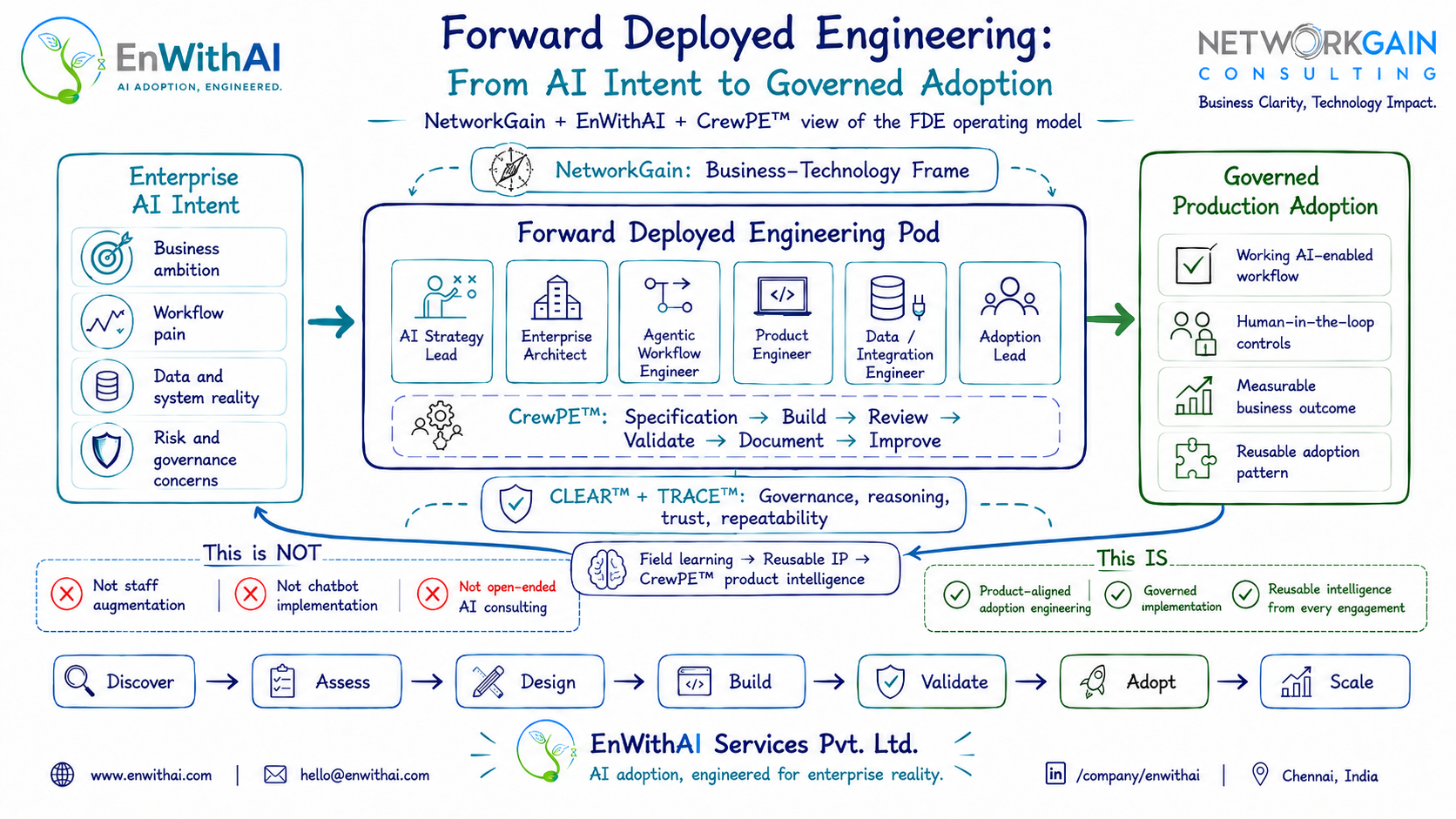
Services become the adoption bridge. CrewPE™ becomes the engineering system. CLEAR™ becomes the reasoning and governance discipline. TRACE™ becomes the trust and repeatability lens.
CrewPE™ as the FDE Operating System
The FDE model becomes powerful only when it has a system behind it.
That system cannot be a shared folder, a few prompts, and individual heroics. It needs a disciplined engineering lifecycle.
This is where CrewPE™ becomes central.
CrewPE™ can act as the operating layer for Forward Deployed Engineering by supporting the full path from problem framing to implementation, review, documentation, validation, and product feedback.
In this model, the FDE does not work alone. The FDE operates inside a governed crew.
The crew may include:
| Role | Primary responsibility |
|---|---|
| AI Strategy Lead | Frames the business problem, value hypothesis, and adoption logic |
| Enterprise Architect | Defines security, systems, deployment, and integration model |
| Agentic Workflow Engineer | Designs workflow decomposition, agent roles, and human review loops |
| Product Engineer | Builds and validates the CrewPE™-aligned implementation |
| Data and Integration Engineer | Handles APIs, identity, data flows, and workflow hooks |
| Adoption Lead | Manages user feedback, change support, and pilot measurement |
| Partner Specialist | Coordinates model, cloud, and implementation ecosystem alignment |
This pod structure is more important than the title.
The real unit of value is not the individual FDE.
It is the Forward Deployed Engineering Pod.
What EnWithAI Services Pvt. Ltd. Should Stand For
EnWithAI Services Pvt. Ltd. should stand for one clear promise:
AI adoption, engineered for enterprise reality.
That promise has substance only if the delivery model is disciplined.
The service architecture should be built around five pillars.
1. AI Adoption Strategy
This is where use cases are discovered, mapped, prioritized, and tested against business value.
The goal is not to create an AI wish list. The goal is to identify where AI can improve a workflow that the business already cares about.
2. Agentic Workflow Design
This is where the work is decomposed.
What should the agent do? What should the human approve? What should be escalated? What should be logged? What should never be automated? What evidence should be retained?
These are operating questions, not just technical questions.
3. AI-Native Product Engineering
This is where intent becomes working capability.
CrewPE™ should support specification-led development, loop-validated implementation, code review, documentation, and product feedback. The aim is not just to ship features. The aim is to create engineering memory.
4. Private and Secure AI Enablement
Many enterprises will not move sensitive workflows into uncontrolled environments.
EnWithAI Services should remain model-agnostic and deployment-aware. It should support cloud, private, CPU-scale, or on-prem possibilities where the enterprise risk profile demands it.
5. Readiness and Governance
This is where CLEAR™ and TRACE™ matter.
The enterprise must know whether the use case is governed, whether the data is ready, whether human review is designed, whether the risk is understood, and whether the outcome can be measured.
AI systems without governance may move fast.
They may also create silent operational risk.
The FDE Is Not a Shortcut Around Governance
A common mistake is to treat FDEs as a way to bypass process.
That is dangerous.
The FDE should not be the person who “just gets it done” outside enterprise discipline. The FDE should be the person who helps the enterprise move faster because the right discipline is built into the work.
Good Forward Deployed Engineering should make governance practical.
It should make security visible earlier. It should make business ownership clearer. It should make implementation more measurable. It should reduce the distance between field reality and product direction.
The best FDEs do not weaken the enterprise operating model.
They sharpen it.
From Deployment to Reusable Intelligence
The most important part of the FDE model is not deployment.
It is learning.
Every customer engagement should generate reusable intelligence:
- What business problem appeared repeatedly?
- What workflow pattern emerged?
- What governance pattern was needed?
- What prompts were reusable?
- What agentic workflow design could become a template?
- What integration pattern should be productized?
- What adoption blocker should be fed back into CrewPE™?
- What risk control should become part of CLEAR™?
- What trust pattern should be aligned with TRACE™?
This is how EnWithAI Services avoids becoming a conventional services organization.
A conventional services organization delivers and moves on.
A product-aligned FDE organization delivers, learns, abstracts, and feeds the product core.
That is the real advantage.
The Adoption Pipeline
A practical FDE-led adoption model should follow a disciplined path:
Discover → Assess → Design → Build → Validate → Adopt → Scale
Each stage should have a gate.
At discovery, the team should ask whether the problem is real and valuable.
At assessment, the team should ask whether the data, workflow, controls, and sponsorship are ready.
At design, the team should define the human-in-the-loop model.
At build, CrewPE™ should enforce engineering discipline.
At validation, the team should test for quality, usability, risk, and operational fit.
At adoption, the team should measure whether people actually use the system.
At scale, the team should convert the engagement into reusable intellectual property.
This is the difference between an AI pilot and an AI adoption system.
What Leaders Should Ask Before Adopting the FDE Model
CXOs and founders should not ask, “Do we need FDEs?”
They should ask better questions:
- Do we have enough clarity on where AI should enter the workflow?
- Do we know which business decisions should remain human-owned?
- Do we have the data and integration readiness for production use?
- Can our engineering team build with governance from day one?
- Can we measure adoption, not just delivery?
- Can every engagement create reusable knowledge?
- Can the field team improve the product core?
If the answers are weak, an FDE model may still help. But only if it is designed as a governed adoption model, not as a capacity model.
The NetworkGain, EnWithAI, and CrewPE™ Position
The NetworkGain position is that Forward Deployed Engineers represent a necessary shift in enterprise technology delivery.
Not because the title is new.
Because the operating need is real.
Enterprises need people and systems that can stand between ambition and reality. They need teams that can understand the business, build with engineering discipline, respect enterprise constraints, and convert field learning into reusable product intelligence.
EnWithAI Services Pvt. Ltd. should occupy that space with clarity.
Not as generic AI consulting.
Not as low-cost implementation.
Not as a training-led movement.
But as a product-aligned AI adoption engineering company that helps enterprises move from AI intent to governed production reality.
CrewPE™ provides the engineering rhythm.
CLEAR™ provides the reasoning and governance discipline.
TRACE™ provides the trust and repeatability lens.
NetworkGain provides the business-technology frame.
Together, they define a sharper version of the FDE model: not forward deployed people alone, but forward deployed intelligence engineered into adoption systems.
Closing View
The future of enterprise AI will not be won by the organization that runs the most pilots.
It will be won by the organization that learns fastest from the field, governs what it builds, and converts every deployment into repeatable intelligence.
That is the real promise of Forward Deployed Engineering.
And that is the space EnWithAI Services Pvt. Ltd. should own.