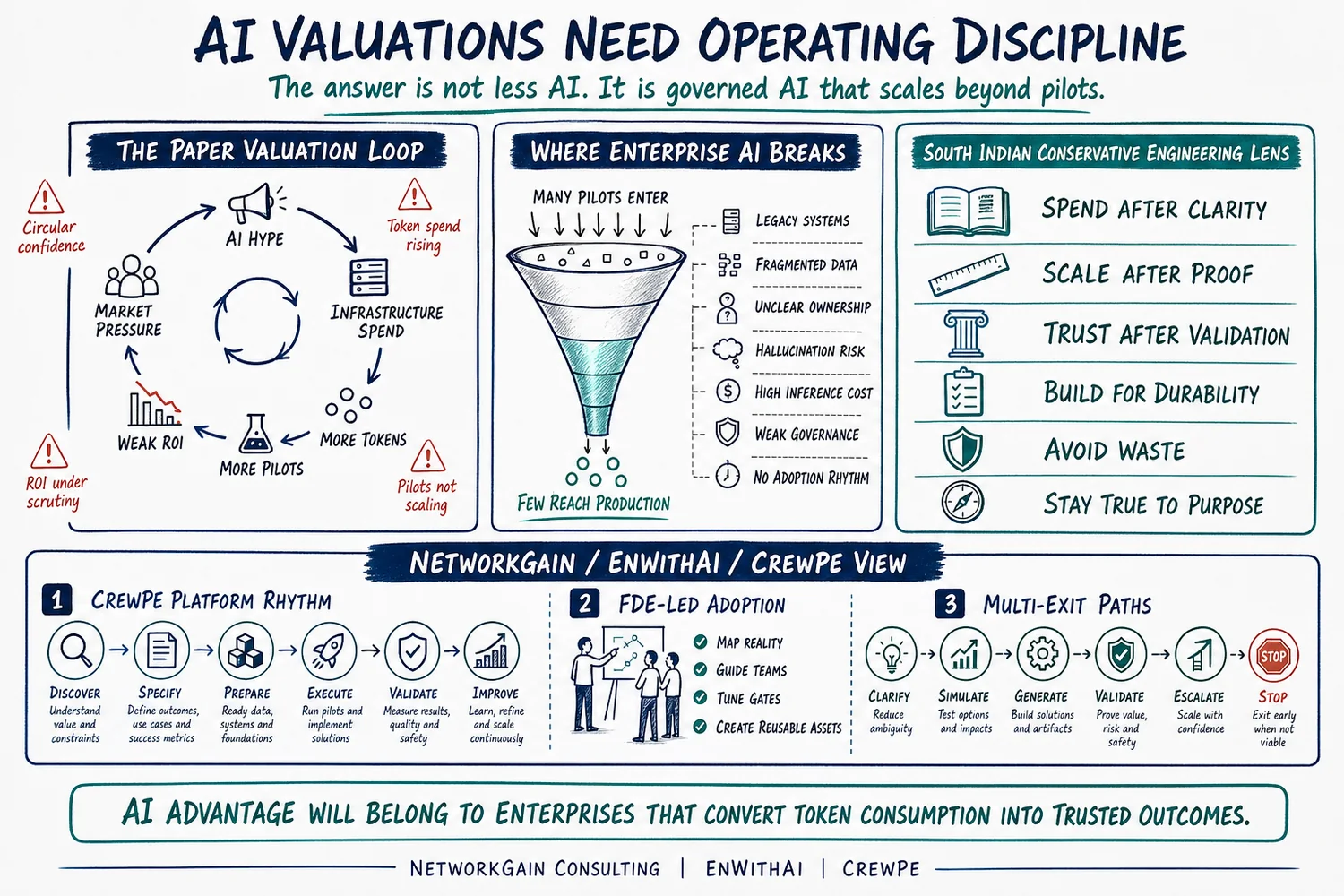
AI is entering its accounting phase.
The first phase was imagination. Leaders saw what generative AI could do and moved quickly. Boards asked for pilots. Technology teams tested tools. Vendors promised acceleration. Investors funded infrastructure. Everyone wanted proof that the new capability was real.
That proof now exists.
The next question is harder: can the investment convert into durable operating advantage?
Recent market commentary has started to ask that question with unusual sharpness. AI infrastructure valuations are being tested. Semiconductor and platform expectations are being questioned. Enterprise pilots are being scrutinized for commercial viability. Token consumption is no longer an invisible technical detail. It is becoming a boardroom cost line.
This is not an argument against AI.
It is an argument against ungoverned AI.
The Signal Behind The Valuation Pressure
The public narrative is now crowded with uncomfortable numbers. Reports and market summaries point to GenAI pilots not delivering expected ROI, proof-of-concept work failing to reach production, token bills rising faster than governance, and enterprises discovering that experimentation does not automatically become adoption.
Even if every number is treated as directional rather than definitive, the signal is clear.
AI is not failing because the models are weak.
AI is struggling because enterprise operating systems are not ready for AI speed.
The gap is not only technical. It is structural.
Most organizations still treat AI as a tool rollout. They begin with licenses, pilots, sandboxes, hackathons, and productivity claims. But AI at scale touches process design, data quality, decision ownership, architecture, security, finance, legal, delivery rhythm, and business accountability.
When those foundations are loose, AI does not remove friction.
It multiplies it.
Pilots Do Not Scale Without An Operating Model
The word “pilot” has become too comfortable.
A pilot allows an organization to say it is moving. It creates visible activity. It offers a controlled place for experimentation. It gives leadership a story to tell.
But pilots often avoid the harder questions:
- Which business process will change?
- Who owns the decision after the model responds?
- What data can be trusted?
- What failure modes are acceptable?
- What cost per outcome is sustainable?
- What will stop, retry, escalate, or exit the workflow?
- What evidence proves that the system is ready for production?
Without those answers, the pilot becomes theatre.
It may look innovative. It may demonstrate capability. It may impress in a meeting. But it does not become a repeatable operating pattern.
That is why NetworkGain has consistently taken a different view.
AI adoption should not begin with the tool.
It should begin with the business frame.
Token Consumption Is The New Cost Discipline
For years, enterprise technology cost discipline was built around infrastructure, licenses, cloud usage, headcount, and project budgets.
AI adds a new variable: token consumption.
Tokens are not just a billing unit. They are a proxy for reasoning, retries, context size, poorly bounded prompts, excessive regeneration, weak verification, and unclear workflow design.
When teams do not specify intent clearly, tokens get spent on ambiguity.
When workflows lack stop rules, tokens get spent on loops that should have ended.
When verification is weak, tokens get spent on rework.
When context is fragmented, tokens get spent rediscovering what the enterprise already knows.
When every team experiments independently, tokens get spent without creating reusable organizational learning.
This is where many AI business cases begin to leak.
The issue is not that AI costs money. Useful technology should cost money. The issue is that token spend must be tied to governed outcomes, not activity volume.
In the AI-native enterprise, consumption discipline becomes execution discipline.
The South Indian Conservative Lens
There is a cultural instinct that has shaped how many South Indian business families, engineers, finance leaders, and operators think about scale.
Do not confuse caution with lack of ambition.
The instinct is simple:
Prove the unit economics before expanding.
Respect cash.
Avoid waste.
Do not mistake visibility for value.
Build reputation slowly.
Let working systems speak louder than aggressive claims.
Scale only after the operating discipline is visible.
This mindset can look conservative from the outside. In AI, it may become a strategic advantage.
Because the AI market has been running on speed, novelty, and valuation momentum. But enterprise adoption rewards a different temperament: patience, verification, measured deployment, accountable ownership, and repeatable proof.
The conservative operating habit says: first make it work, then make it reliable, then make it repeatable, then scale it.
That is not old thinking.
It is exactly what AI now needs.
NetworkGain’s View: Clarity Before Consumption
NetworkGain’s philosophy has always been anchored in business clarity and technology impact.
AI does not change that principle. It makes it more important.
If business intent is unclear, AI will accelerate confusion.
If process ownership is weak, AI will distribute accountability until nobody owns the outcome.
If data is fragmented, AI will create confident answers on unstable foundations.
If governance is absent, AI will convert experimentation into uncontrolled cost.
If architecture is brittle, AI will expose every hidden integration weakness.
The right response is not to pause AI.
The right response is to govern AI adoption as an operating discipline.
That means every AI initiative should be judged by a few practical questions:
- What business outcome is being improved?
- What process will change?
- What evidence will prove readiness?
- What human decision points are required?
- What token consumption is acceptable for the value created?
- What reusable asset will remain after the engagement?
- What exit path exists if the use case is not commercially viable?
These are not bureaucratic questions.
They are survival questions.
Why EnWithAI And CrewPE Fit This Moment
EnWithAI was created around one belief: AI intent must become trusted execution.
That requires more than prompts. It requires a system that connects strategy, workflow design, product engineering, governance, validation, adoption, and learning.
CrewPE carries that principle into execution.
Its rhythm is deliberate:
Discover -> Specify -> Prepare -> Execute -> Validate -> Improve
This sequence matters because it prevents AI work from becoming a loose collection of experiments.
Discover clarifies the business problem.
Specify converts intent into testable constraints.
Prepare organizes the context, workflow, prompts, acceptance criteria, and engineering assets.
Execute allows AI and humans to move with speed.
Validate checks whether the result is trusted.
Improve converts the learning into reusable intelligence.
This is how AI spend becomes institutional capability.
It is also how enterprises avoid being trapped by one tool, one model, one vendor, or one overfunded platform assumption.
CrewPE is not designed around blind dependence on a single AI system. It is designed around governed execution, multi-exit paths, and traceable confidence. The platform should help teams choose the right path: automate, assist, escalate, redesign, defer, or stop.
That flexibility matters in a market where model costs, tool economics, regulation, and enterprise expectations are all moving.
The Role Of Forward Deployed Engineering
AI adoption cannot be solved only from a desk.
The hardest issues live inside workflows, operating habits, data realities, exception paths, customer commitments, compliance boundaries, and informal decisions that never appear in process maps.
That is why Forward Deployed Engineering matters.
The FDE role is not staff augmentation. It is not generic AI consulting. It is not chatbot implementation.
It is the discipline of entering the operating environment, understanding the business problem, designing governed workflows, validating adoption, and converting field learning into reusable assets.
For NetworkGain, EnWithAI, and CrewPE, this is where the approach becomes practical.
AI cannot remain a presentation layer.
It has to meet the shop floor, the finance review, the sales process, the engineering backlog, the service desk, the customer exception, the regulatory constraint, and the management rhythm.
Only then can AI move from pilot to production.
What Leaders Should Do Now
The market correction around AI should not create panic.
It should create discipline.
Leaders should resist two extreme reactions.
The first is blind acceleration: keep spending because competitors are spending.
The second is defensive withdrawal: pause AI because the market is questioning valuations.
Both are weak responses.
The stronger response is selective, governed adoption.
Start with problems that matter. Define the operating frame. Measure token consumption against business value. Build verification into the workflow. Create reusable assets from every implementation. Keep humans accountable for decisions that carry risk. Give teams clear exit paths when the economics do not hold.
This is how enterprises move from AI excitement to AI capability.
NetworkGain Perspective
The AI market is not asking whether AI is powerful.
That question is settled.
The market is asking whether enterprises can convert AI power into reliable economics.
That is the real test.
The organizations that win will not be the ones with the loudest AI narratives or the largest pilot portfolios. They will be the ones that combine ambition with restraint, experimentation with governance, token consumption with value discipline, and execution speed with operating clarity.
In that sense, the conservative instinct may be ahead of the curve.
Do not spend before you understand.
Do not scale before you validate.
Do not automate before you assign accountability.
Do not celebrate pilots before they become operating assets.
AI advantage will belong to enterprises that convert token consumption into trusted outcomes.
That is the NetworkGain view.
That is the EnWithAI promise.
And that is the CrewPE principle.