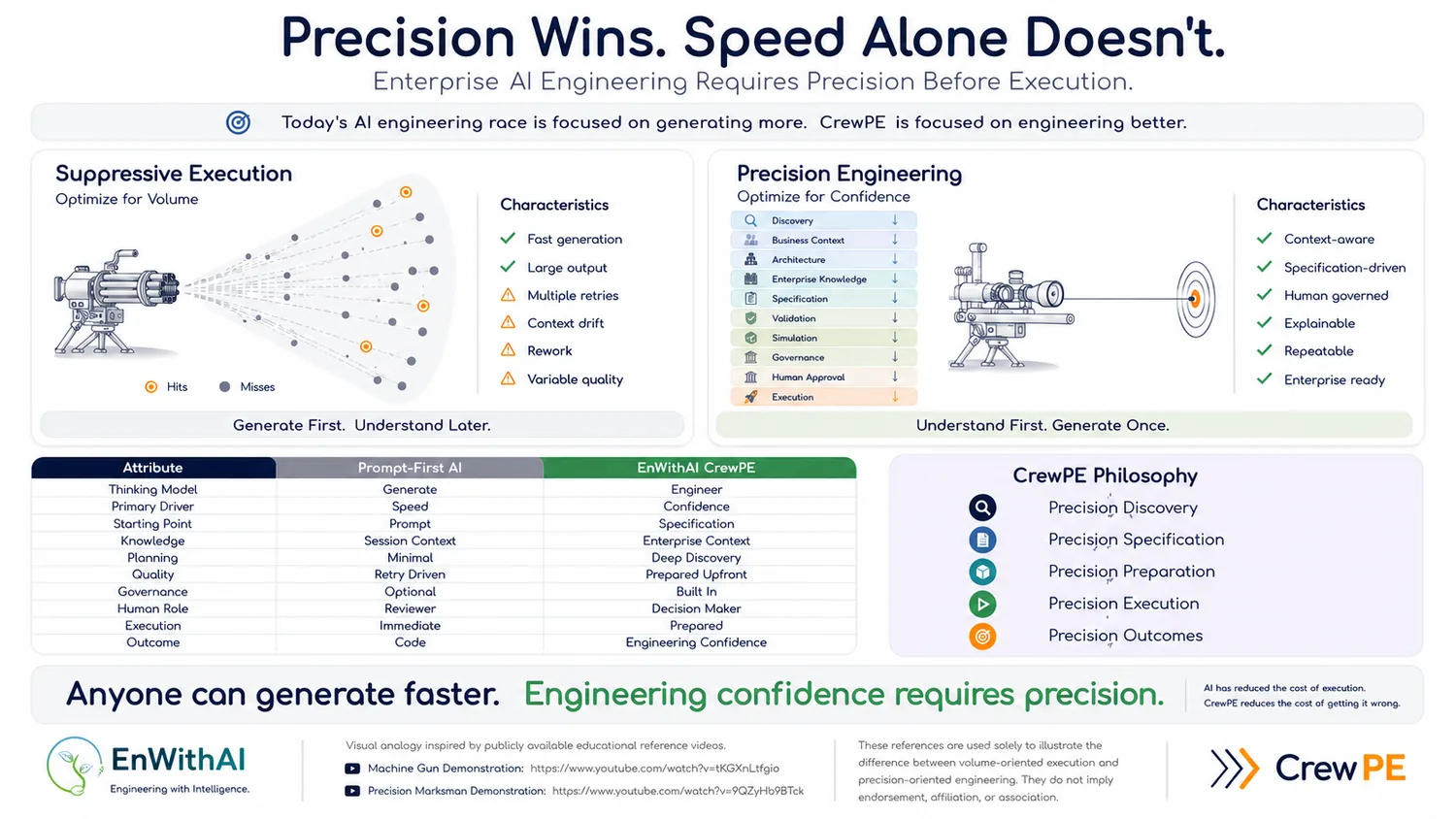
Enterprise AI engineering is moving beyond code generation.
The real challenge is no longer how quickly code can be produced. It is how confidently the right outcome can be engineered.
The current AI engineering race is still largely focused on speed.
Generate faster. Write more code. Complete more tasks. Compress delivery timelines.
That progress is valuable. AI has materially reduced the cost of execution.
But speed solves only one part of the engineering problem.
It does not automatically solve for context, architectural fit, enterprise knowledge, governance, traceability, validation, or business relevance.
This creates an important distinction.
Some AI engineering approaches are designed for volume-oriented execution. They begin with a prompt, generate an output, and rely on subsequent review, correction, and repetition to reach an acceptable result.
EnWithAI CrewPE begins elsewhere.
It starts by engineering the conditions required for the right outcome.
Two Different Engineering Philosophies
The visual analogy of suppressive execution versus precision engineering is not about weapons.
It is about how execution is approached.
A volume-oriented model is designed to produce many actions quickly. Some will hit the intended objective. Others will miss, drift, or require correction.
A precision-oriented model invests more effort before execution.
It establishes:
- What problem is actually being solved
- Which business outcome matters
- What enterprise context must be preserved
- Which architectural constraints apply
- What specification should govern the work
- How the result will be validated
- Where human judgment is required
- When execution is ready to begin
The distinction is simple.
Generate first. Understand later.
Or:
Understand first. Generate once.
Neither speed nor generation is the enemy.
The problem begins when generation is mistaken for engineering.
From Prompt-First Execution To Specification-Led Engineering
Prompt-first tools are useful because they reduce friction. A developer can describe intent and receive a working response almost immediately.
But enterprise software rarely exists as an isolated prompt-response problem.
It exists inside a larger system of:
- Business rules
- Legacy dependencies
- Security policies
- Regulatory obligations
- Domain knowledge
- Integration constraints
- Operational expectations
- Human accountability
When this context is absent, the result may still appear correct at the code level while being incomplete or unsuitable at the enterprise level.
This is where the difference between AI-assisted coding and AI-native engineering becomes visible.
AI-assisted coding accelerates output.
AI-native engineering has to protect outcomes.
CrewPE is designed around that second requirement.
The CrewPE Sequence
CrewPE follows a different execution sequence.
Precision Discovery clarifies the business need, engineering objective, user context, operating constraint, and decision frame.
Precision Specification translates intent into explicit, testable, and reviewable requirements.
Precision Preparation brings together architecture, enterprise knowledge, validation criteria, simulation, and governance controls before execution begins.
Precision Execution generates or modifies code only after the required context and decisions are in place.
Precision Outcomes measure success through engineering confidence, repeatability, traceability, and business relevance.
What this really means is that execution becomes the final step, not the first reaction.
That is a significant shift.
In conventional AI usage, the prompt is often treated as the starting point. In enterprise engineering, the prompt should be the last mile expression of a much deeper specification.
The value is not only in producing an answer.
The value is in making sure the answer was worth producing.
The Hidden Cost Of Getting It Wrong
AI has reduced the cost of producing software.
It has not eliminated the cost of misunderstanding the requirement.
A rapidly generated solution can still create:
- Rework
- Technical debt
- Architectural inconsistency
- Security exposure
- Compliance risk
- Operational instability
- Loss of trust
- Delayed business outcomes
In many enterprise environments, the costliest failure is not slow coding.
It is confidently building the wrong thing.
That is why speed alone is an incomplete measure of AI engineering productivity.
A more meaningful question is:
How much confidence do we have that the generated outcome is correct, explainable, governed, and fit for its intended purpose?
That question moves the conversation from code volume to engineering confidence.
The Human Role Changes
In prompt-first engineering, the human often becomes the reviewer of machine-generated output.
In precision engineering, the human remains the decision-maker.
That distinction matters.
The system can discover, reason, simulate, generate, and validate. But critical decisions must remain visible and governed. Enterprise AI engineering cannot bury judgment inside a black-box execution chain and call the result productivity.
AI accelerates execution.
Humans preserve intent, judgment, and accountability.
The healthiest model is not human versus AI.
It is human-governed AI execution with a clear specification, traceable evidence, and explicit confidence signals.
What Enterprises Should Measure
The next generation of AI engineering platforms should not be assessed only on lines of code generated or tasks completed.
Enterprises should also measure:
- Requirement clarity before execution
- Context completeness
- Specification quality
- First-pass acceptance
- Rework avoided
- Defect escape rate
- Traceability of decisions
- Human approval points
- Architecture compliance
- Time to engineering confidence
- Business outcome alignment
These measures move the conversation from coding productivity to engineering effectiveness.
They also reveal the true role of CrewPE.
CrewPE is not designed to make AI look busier.
It is designed to make AI-assisted engineering more precise, governed, repeatable, and trusted.
The NetworkGain Perspective
The market is moving from AI-assisted coding toward AI-governed engineering.
Coding assistants will remain valuable. They are becoming faster, more capable, and increasingly embedded in developer workflows.
But the enterprise control layer above them will matter even more.
That layer must connect business intent, enterprise knowledge, architecture, specification, governance, and execution into one coherent engineering system.
This is the space CrewPE is designed to address.
It is not simply another interface for generating code.
It is an engineering lifecycle system that prepares the work before execution and preserves confidence after execution.
Anyone can generate faster.
Engineering confidence requires precision.
AI has reduced the cost of execution.
CrewPE is designed to reduce the cost of getting it wrong.
That is the more durable enterprise advantage.