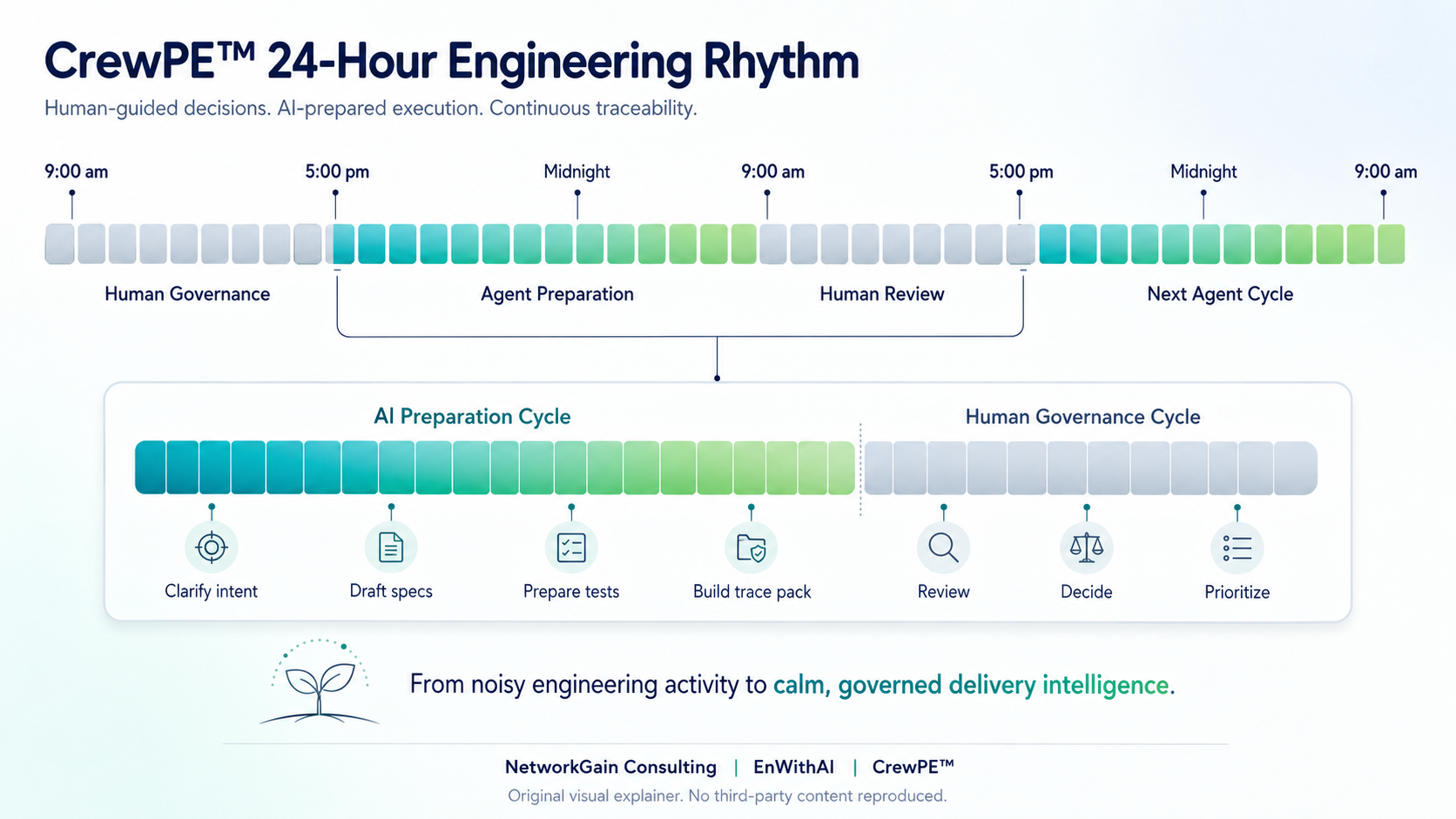
AI has made software generation cheaper.
It has not made software trust cheaper.
That is the important shift product and engineering leaders must now confront. Coding agents can produce a pull request quickly. They can write tests, draft documentation, refactor modules, and suggest architecture changes with increasing fluency. But the enterprise still has to answer the harder question:
Can we trust what was produced?
That question is where time now leaks.
The next delivery bottleneck is not code creation. It is verification.
This is why CrewPE matters.
The New Constraint
For years, software organizations treated implementation capacity as the constraint.
If delivery was slow, the answer was usually more engineering capacity, stronger tooling, clearer backlog management, better DevOps automation, or improved platform support.
AI coding changes that equation.
Generation speed is no longer the scarce resource. A capable agent can produce a first draft of code, tests, documentation, and implementation notes in minutes. The visible output arrives faster than many teams can review it.
That creates a new operating problem.
When output becomes abundant, confidence becomes scarce.
The review burden does not disappear because an agent generated the work. In many cases, review becomes harder because agent output can look clean, complete, and confident even when it is subtly wrong.
The risk is not that AI produces messy work.
The risk is that AI produces plausible work that passes a surface-level inspection.
The Audit Tax
A recent Agent Native Engineering field note on “hard to eval” as a product smell frames the issue sharply: generation is cheap now, so verification becomes the binding cost.
The same cluster of observations points to what some practitioners are calling the audit tax.
The agent writes the pull request quickly. The human spends far longer deciding whether to trust it. The claimed gain in generation speed is then partially consumed by review, rework, context reconstruction, and confidence building.
This matters because reviewing an agent’s output is not the same as reviewing a human teammate’s work.
With a human, reviewers often have conversational context. They may know the engineer’s reasoning, prior design discussion, trade-offs, and likely blind spots. With an agent, the output can arrive without enough provenance. It may not expose what assumptions were made, what sources were used, what alternatives were rejected, or where uncertainty remains.
The result is a new kind of delivery drag.
Teams do not only review the code.
They review the reasoning they cannot see.
Hard To Eval Is A Product Smell
The phrase “hard to eval” is useful because it shifts the conversation.
Many teams treat evaluation as something added after the product, workflow, or AI agent is already built. The system produces output. Users struggle to judge it. Reviewers invent checks. Leaders ask for dashboards. Quality teams ask for metrics.
That sequence is backwards.
If an output is hard to evaluate, the problem may not be the eval framework.
The problem may be the design.
A product, feature, or agent workflow should be designed so the output is checkable. It should expose enough evidence for users, reviewers, and automated checks to decide whether it is good. It should not force the reviewer to reconstruct the entire task from scratch.
In AI-native product engineering, verification cannot be a late-stage inspection layer.
It must be designed into the work.
Why Conventional SDLC Is Not Enough
Traditional SDLC assumed that humans performed most of the interpretation and execution.
Requirements were clarified through meetings. Engineers translated intent into implementation. Reviewers checked code. Testers validated behavior. Product owners accepted or rejected outcomes.
AI-native delivery changes the rhythm.
Agents can now participate in discovery, specification, implementation, test generation, documentation, refactoring, and review support. Work can move faster, but the accountability chain becomes more complex.
Leaders therefore need to manage new questions:
- What was the product intent?
- Which specification did the agent follow?
- What context was loaded?
- Which constraints were enforced?
- Which checks were deterministic?
- Which checks used model judgment?
- What evidence proves readiness?
- What uncertainty remains?
- Who accepted the residual risk?
If these questions are not designed into the workflow, verification becomes a manual hunt.
That is the audit tax in operating form.
Why CrewPE Is Built For This Moment
CrewPE exists because AI-native product engineering needs a stronger control layer between intent and release.
The point is not to slow down AI coding.
The point is to make AI coding trustable.
CrewPE does that through a disciplined execution model:
Discover -> Specify -> Prepare -> Execute -> Validate -> Improve
The important shift is that verification does not begin at Validate.
Verification begins at Discover.
During Discover, the team clarifies the business problem, user context, operating constraints, risk boundaries, and success measures. That gives the work a reason to exist.
During Specify, the team turns intent into acceptance logic. What must be true for the output to be considered correct? What evidence should be produced? Which edge cases matter? Which constraints cannot be violated?
During Prepare, the team assembles the prompts, repository context, test expectations, data references, dependency assumptions, and review plan. This reduces the invisible reasoning gap.
During Execute, agents and engineers can move quickly, but inside a bounded execution frame.
During Validate, the work is checked against the specification, not against the confidence of the generated output.
During Improve, failure modes become reusable product intelligence.
That is why CrewPE’s operating principle matters:
Specification-led. Loop-validated. Confidence-scored.
Specification-Led Means The Work Is Checkable
AI coding often fails downstream because the upstream instruction was too loose.
The agent did not misunderstand code.
It inherited ambiguity.
Specification-led delivery fixes this by making acceptance criteria explicit before generation begins. The specification should define what the system must do, what it must not do, what evidence must be produced, and which trade-offs require human decision.
This changes the role of the reviewer.
The reviewer is no longer asked to inspect an opaque output and decide whether it “seems right.” The reviewer is given an artifact designed for checking.
That is the difference between review as judgment archaeology and review as verification.
Loop-Validated Means Quality Is Built Through Iteration
One AI-generated output should not be treated as delivery.
AI-native work needs loops: generate, test, inspect, repair, document, and recheck.
Some checks should be cheap and deterministic: type checks, linting, unit tests, schema validation, dependency scans, security rules, API contract tests, and build verification.
Some checks require model-assisted review: consistency checks, scenario coverage, user-story alignment, documentation completeness, and risk summaries.
Some checks require human judgment: product fit, business risk, architectural direction, brand sensitivity, customer impact, and release readiness.
The mistake is to collapse all of these into one human review.
CrewPE separates them into a delivery rhythm so expensive human attention is spent where judgment matters most.
Confidence-Scored Means Release Is Evidence-Based
AI output should not be accepted because it is fluent.
It should be accepted because there is evidence.
Confidence scoring does not mean pretending quality can be reduced to a single number. It means making readiness visible across the dimensions that matter:
- Specification coverage
- Test pass status
- Known gaps
- Security and compliance checks
- Architecture fit
- Review exceptions
- User acceptance signals
- Cost and token exposure
- Traceability from intent to implementation
When these signals are visible, leaders can make better release decisions.
When they are hidden, the organization depends on reviewer intuition.
That is not a scalable AI-native delivery model.
The NetworkGain View
NetworkGain’s view is straightforward.
AI coding is useful, but it is not the transformation.
The transformation is the redesign of software delivery around verifiable work.
The winners will not be the organizations that generate the most code. They will be the organizations that can convert intent into validated software repeatedly, economically, and with confidence.
This is where CrewPE has a clear role.
CrewPE is not another coding assistant. It is a guided product engineering discipline for the agentic era. It helps teams define intent, prepare execution, govern agentic workflows, validate outcomes, and turn delivery learning into reusable product intelligence.
It recognizes a simple reality:
When generation is cheap, verification becomes strategy.
What Leaders Should Do Next
Before scaling AI coding across teams, leaders should ask five questions.
First, are product outputs designed to be checkable?
Second, do specifications define acceptance evidence before implementation begins?
Third, are cheap deterministic checks run before expensive human review?
Fourth, is model-assisted review independent enough to catch likely blind spots?
Fifth, are failures captured as reusable learning for the next cycle?
If the answer is no, the organization does not yet have an AI-native delivery system.
It has faster code generation attached to a human audit queue.
That may look productive for a short time.
It will not scale.
The future of AI-native product engineering belongs to teams that design for verification first.
CrewPE exists for that future.