McKinsey’s article on rewiring software delivery for the agentic era is directionally correct. It recognizes that software delivery is moving toward human-agent collaboration, 24-hour execution cycles, knowledge infrastructure, machine-readable specifications, and smaller, more productive teams.
Those are important signals.
But they are not the full operating model.
NetworkGain’s view is that agentic software delivery will not mature simply because teams add more agents, more automation, or more continuous execution.
It will mature when enterprises can trust autonomous execution.
That is the missing layer.
And that is exactly what TRACE™ was designed to solve.
Source note: This Perspective is informed by McKinsey’s article, “Rewiring software delivery for the agentic era.” NetworkGain has evolved the topic here into an execution-led view on trust, governance, product intelligence, and AI-native engineering discipline.
The Industry Is Optimizing for Velocity
Most discussions around agentic SDLC focus on speed.
Faster coding.
More agents.
Continuous delivery.
Smaller teams.
Lower cost.
Higher throughput.
These are useful outcomes. But they are not the operating model.
The real question is more difficult:
How do you trust a software delivery system where humans are no longer performing most of the execution?
That is the question many organizations are not yet answering.
An enterprise can automate code generation and still fail at delivery. It can run agents overnight and still produce ambiguity at scale. It can compress engineering cycles and still create more risk than value.
Velocity matters only when the system knows what it is accelerating.
The New Constraint Is Not Coding
For decades, software delivery moved through a familiar sequence:
Business intent → Requirements → Design → Code → Test → Deploy
Coding was often the visible bottleneck.
AI changes that constraint.
Code can now be generated faster. Tests can be proposed faster. Documentation can be drafted faster. Pull requests can be reviewed faster. Architecture options can be explored faster.
The new bottleneck is not typing.
The new bottleneck is trust.
More specifically, the bottleneck is the enterprise’s ability to manage:
- Intent
- Alignment
- Context
- Governance
- Validation
- Traceability
- Accountability
McKinsey correctly identifies the need for structured requirements, architectural discipline, knowledge graphs, and machine-readable handoffs.
NetworkGain’s view is that these are all manifestations of a deeper principle:
Agentic systems fail when trust cannot scale.
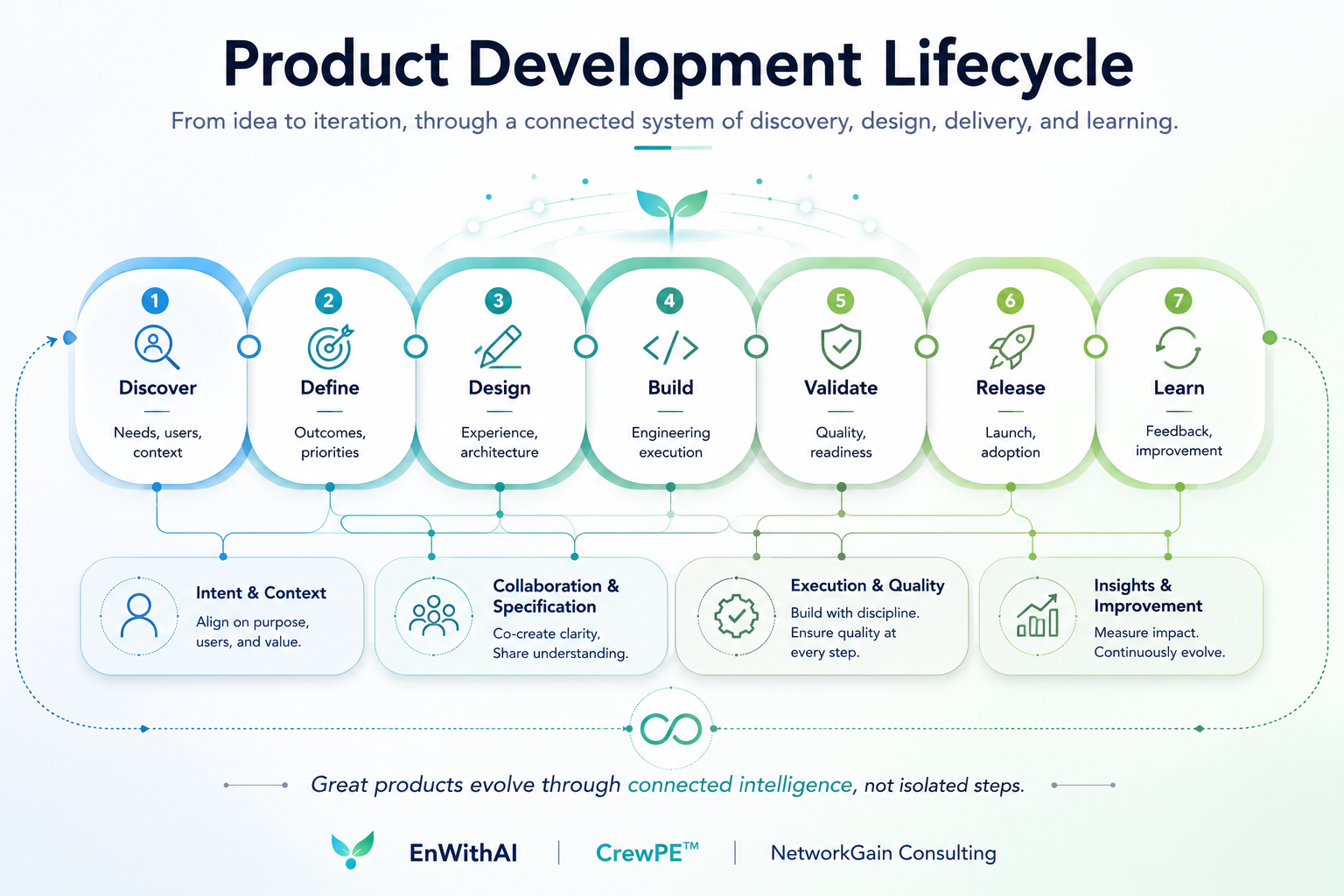
Why TRACE™ Exists
TRACE™ stands for:
Trustworthy. Repeatable. Agentic. Collaborative. Engineering.
Every word matters.
Trustworthy
Can we explain why the system produced this outcome?
Can we trace decisions, audit behavior, govern risk, and understand where human judgment shaped the result?
Repeatable
Can the same operating pattern produce consistent results tomorrow?
Can it scale across teams, products, platforms, and business units?
Can it survive personnel changes without losing context?
Agentic
Can intelligent agents perform meaningful work?
Can they operate autonomously within defined boundaries, acceptance criteria, and escalation paths?
Collaborative
Can humans and agents function as one delivery system?
Can product, architecture, engineering, security, operations, and business stakeholders stay aligned while execution accelerates?
Engineering
Can the organization reliably convert intent into outcomes?
Can it move beyond experimentation into production-grade execution discipline?
That is the real challenge.
Agentic SDLC without TRACE™ may increase throughput.
TRACE™ SDLC increases confidence.
Why CrewPE™ Exists
This is exactly where CrewPE™ enters.
Most AI coding tools start with code.
CrewPE™ starts with intent.
Most tools optimize:
Prompt → Code
CrewPE™ optimizes:
Intent → Specification → Preparation → Execution → Validation → Improvement
That distinction is decisive.
When AI can produce software quickly, ambiguity becomes more expensive. When agents can execute independently, governance becomes more important. When work moves across humans and machines, traceability becomes the management system.
CrewPE™ is built around three principles:
Specification-Led™
Because ambiguity is expensive.
Loop-Validated™
Because generation is not validation.
Confidence-Scored™
Because output without confidence is risk.
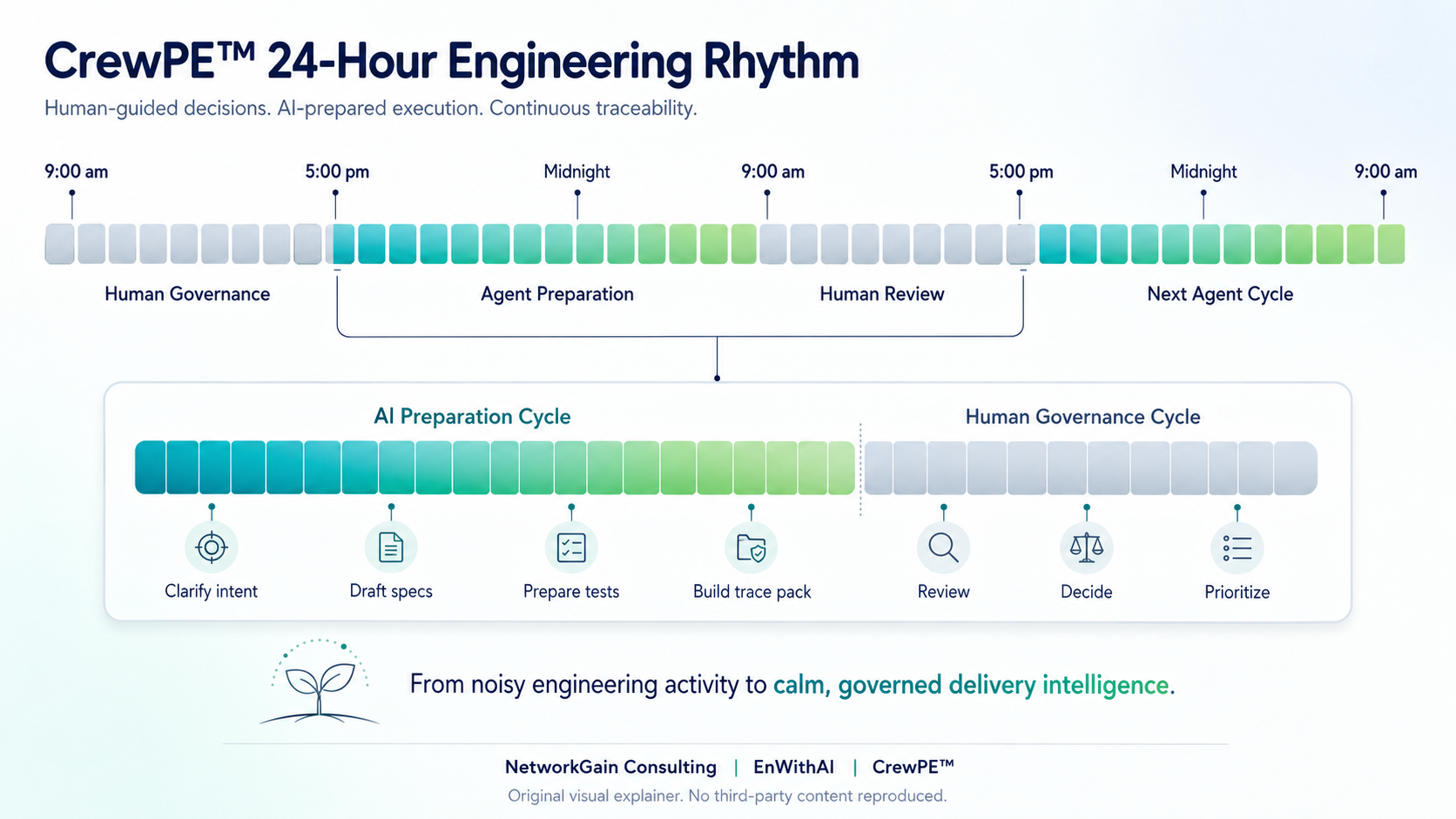
The Missing Layer in Agentic SDLC
The McKinsey article discusses agent factories, knowledge graphs, automated handoffs, 24-hour delivery cycles, smaller teams, and AI-enabled engineers.
All of those are valid.
But the discussion implicitly assumes something important:
The organization already knows how to structure intent.
Most organizations do not.
That is where delivery breaks.
Not in coding alone.
Not in deployment alone.
Not in AI alone.
Projects fail because requirements are unclear, decisions are undocumented, context is fragmented, validation criteria are weak, knowledge is tribal, and governance is reactive.
Simply deploying agents does not solve those problems.
It can amplify them.
If the operating model is unclear, agents accelerate uncertainty. If context is fragmented, agents generate plausible but disconnected outputs. If validation is weak, agents create more artifacts than evidence. If ownership is unclear, agents distribute accountability until no one truly owns the outcome.
The problem is not whether agents can do work.
The problem is whether the enterprise can govern the work agents do.
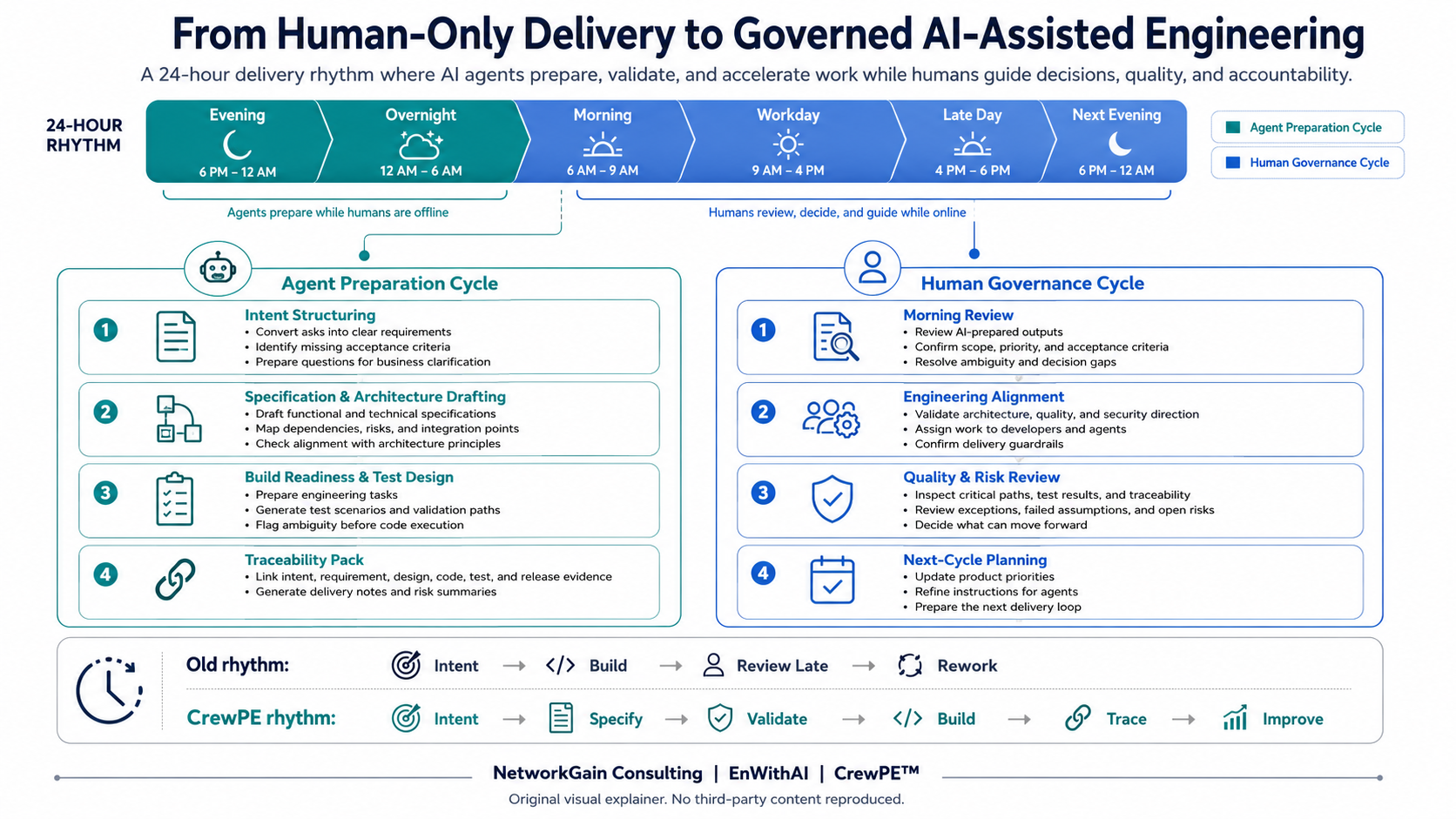
From Human-Only Delivery to Governed AI-Assisted Engineering
The agentic era does not remove humans from software delivery.
It changes where human judgment matters most.
Human effort should move away from repetitive execution and toward intent framing, constraint definition, prioritization, quality review, risk decisions, and learning loops.
Agents should prepare structured work, draft specifications, identify gaps, generate tests, build trace packs, and accelerate execution inside known boundaries.
This creates a new delivery rhythm:
- Humans clarify intent and business priority.
- Agents prepare specifications, test paths, and execution-ready work.
- Humans review ambiguity, risk, quality, and trade-offs.
- Agents execute within governed constraints.
- Humans decide what moves forward.
- The system learns from evidence.
This is not a handoff model.
It is a governed collaboration model.
The Future Is Not Agentic SDLC
This is NetworkGain’s strongest point of view.
Many people think the future is:
Agentic SDLC
We believe the future is:
TRACE™ SDLC
The difference is subtle but profound.
Agentic SDLC asks:
How do we automate software delivery?
TRACE™ SDLC asks:
How do we create trustworthy autonomous execution?
That distinction changes everything.
Enterprises do not buy automation for its own sake.
They buy predictability.
They buy accountability.
They buy outcomes.
They buy trust.
Where EnWithAI™ Fits
EnWithAI™ exists because AI adoption is not fundamentally a technology problem.
It is an execution problem.
Organizations already have models, agents, copilots, frameworks, and APIs.
What they often lack is a reliable path from:
AI Intent → Trusted Execution™
That is the EnWithAI™ mission.
EnWithAI™ helps organizations convert AI ambition into governed operating capability. CrewPE™ provides the product engineering discipline. TRACE™ provides the trust model. CLEAR™ provides the executive alignment frame:
Clarity. Leadership. Execution. Accountability. Results.
Together, these ideas create a more complete answer to the agentic era.
Not more automation alone.
Governed execution.
Not faster coding alone.
Trusted delivery.
Not isolated tools.
Connected product intelligence.
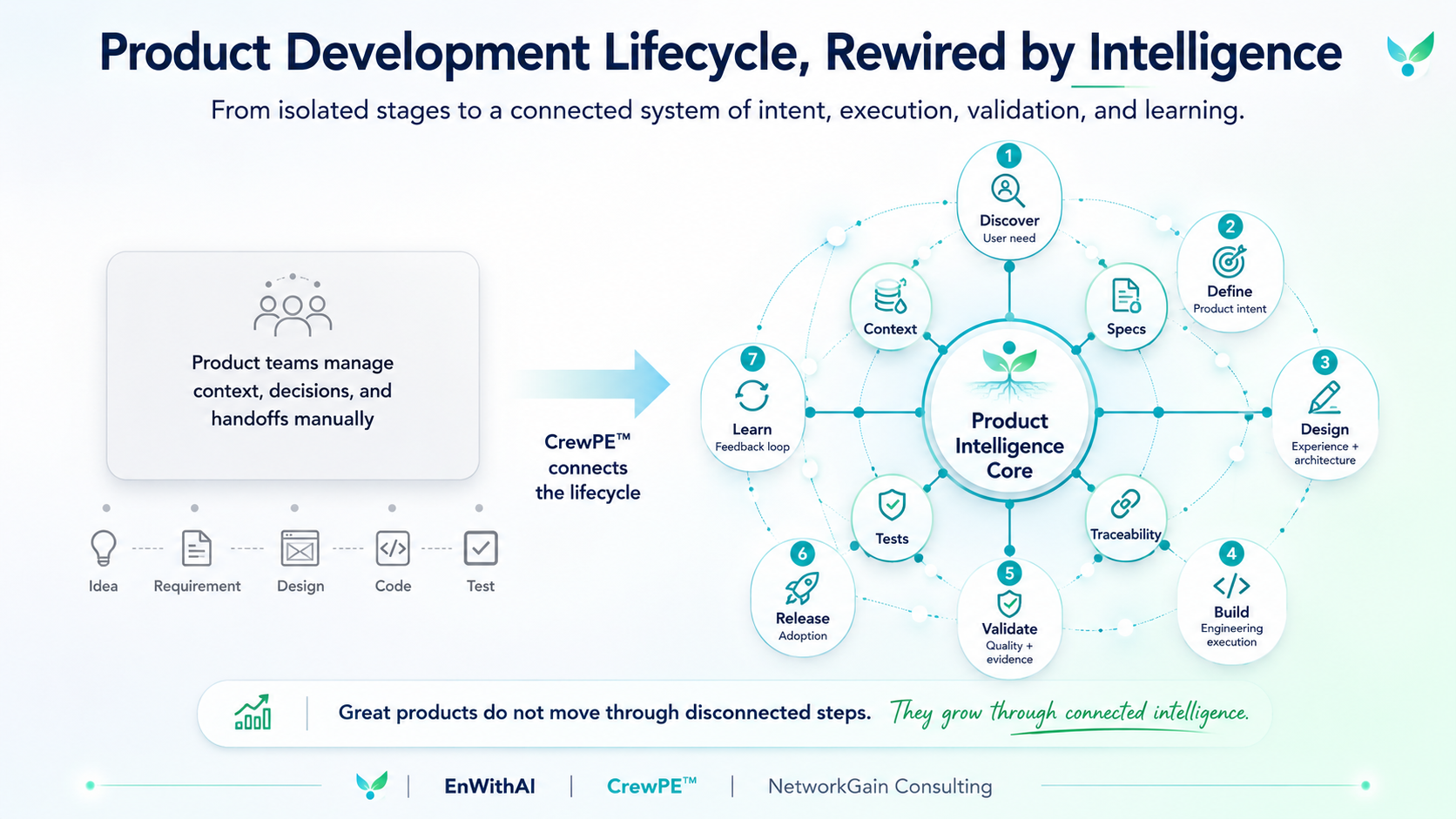
What Leaders Should Do Next
Before expanding agentic software delivery initiatives, leaders should ask six questions:
- How is product intent specified before agents begin execution?
- What context is available to agents, and how is it kept current?
- Which decisions require human governance?
- What validation evidence is required before release?
- How is confidence scored across requirements, architecture, code, tests, and risk?
- How does the delivery system learn from each cycle?
If those questions cannot be answered clearly, the organization does not yet have an agentic delivery model.
It has AI-assisted engineering activity.
The next generation of software delivery requires something stronger.
It requires TRACE™.
NetworkGain Perspective
The future of software delivery will not be determined by which enterprise has the most agents.
It will be determined by which enterprise can create the most trustworthy collaboration between people, product intelligence, engineering discipline, and autonomous execution.
Velocity will matter.
But only when it is governed.
Automation will matter.
But only when it is traceable.
AI will matter.
But only when it converts intent into reliable outcomes.
That is the NetworkGain view.
Agentic delivery is the direction of travel.
TRACE™ SDLC is the operating discipline that makes it trustworthy.