A recent article by Jeff Gothelf highlighted an observation that many technology leaders are beginning to discover firsthand: what Andrej Karpathy describes as agentic engineering looks remarkably similar to what great product managers have always done: defining intent, supervising execution, validating outcomes, and learning from results. The article argues that much of what is being labeled as agentic engineering is fundamentally product management in a new execution environment.
We agree with the core insight.
But we believe the industry has not gone far enough.
The next evolution is not simply agentic engineering.
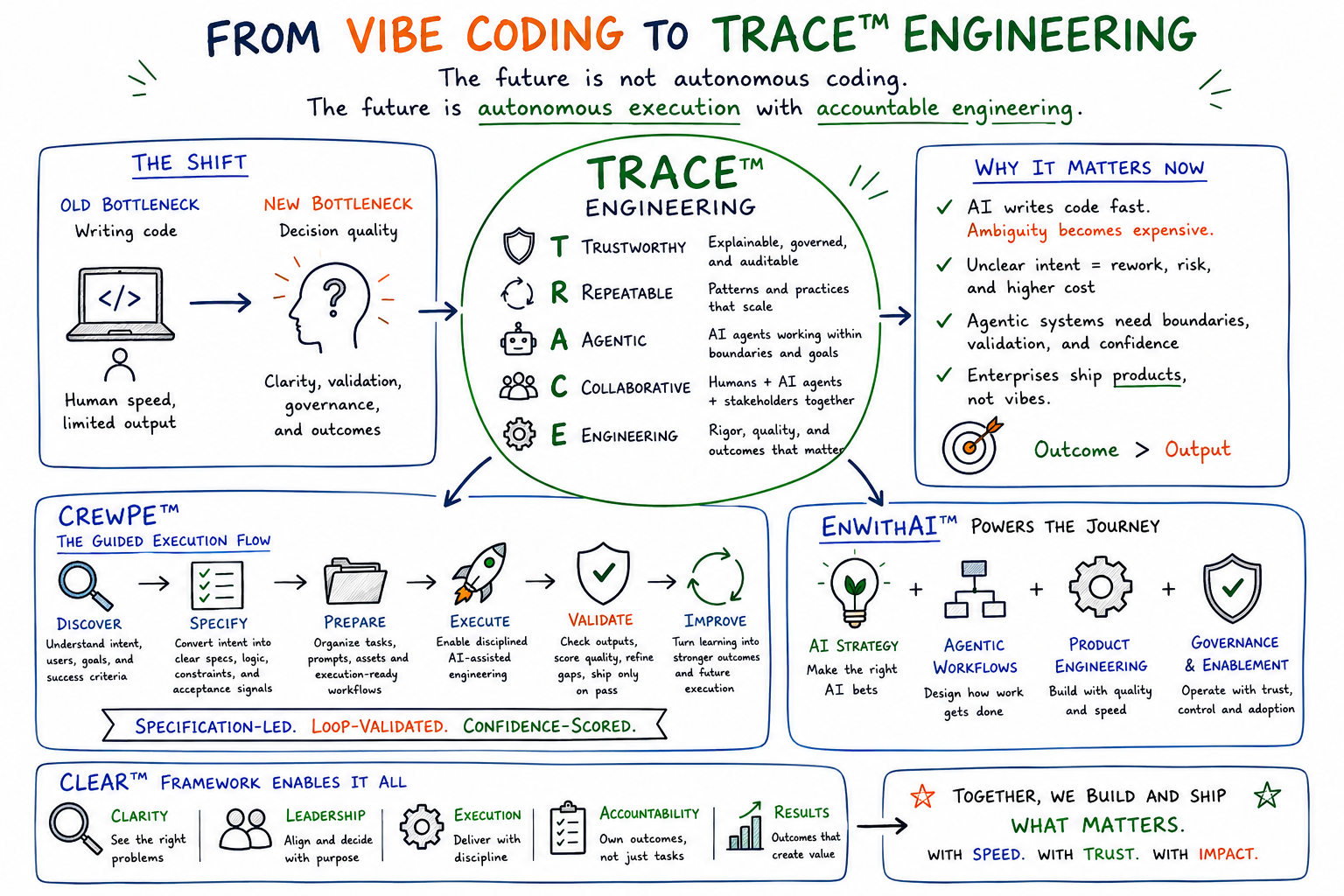
The next evolution is TRACE™ Engineering.
Trustworthy. Repeatable. Agentic. Collaborative. Engineering.
And that is precisely why CrewPE™ exists.
The Real Shift Is Not Coding
For decades, software engineering was constrained by the speed at which humans could write code.
Today, that constraint is disappearing.
AI can generate code.
AI can generate tests.
AI can review pull requests.
AI can propose architecture.
AI can create documentation.
The new bottleneck is no longer code production.
The bottleneck is deciding:
- What should be built?
- Why should it be built?
- How do we know it is correct?
- When is it ready?
- Who is accountable?
- What happens when autonomous systems disagree?
- How do we scale judgment?
Karpathy’s observation is important because it recognizes that the scarce resource is no longer typing.
It is decision quality.
That is not a coding problem.
It is an engineering governance problem.
Why Vibe Coding Was Never the Destination
Vibe coding was useful because it demonstrated what AI could do.
But it was never an enterprise operating model.
Enterprises do not ship vibes.
They ship products.
Products require:
- Requirements
- Constraints
- Security
- Architecture
- Validation
- Compliance
- Accountability
- Business outcomes
The moment AI moves from experimentation into production, organizations need more than code generation.
They need engineering discipline that can operate at AI speed.
The Missing Layer: TRACE™
The industry conversation often swings between two extremes:
Traditional SDLC
or
Fully Autonomous AI
Neither is sufficient.
Traditional SDLC assumes humans perform most execution.
Fully autonomous models assume AI can reliably determine intent, constraints, trade-offs, and success criteria.
The reality is somewhere in between.
The future belongs to organizations that can orchestrate humans and AI agents together.
This requires TRACE™.
Trustworthy
Every decision, recommendation, specification, prompt, workflow, and generated artifact must be explainable, governed, auditable, and aligned to business intent.
Trust cannot be an afterthought.
Repeatable
One successful AI-assisted delivery does not create transformation.
Organizations need repeatable execution patterns that scale across teams, products, and business units.
Agentic
AI agents should perform meaningful work.
But autonomy must operate within specifications, governance boundaries, evaluation loops, and acceptance criteria.
Collaborative
The future is not humans versus AI.
It is product leaders, architects, engineers, operators, business stakeholders, and intelligent agents operating as a coordinated system.
Engineering
Engineering remains the discipline that converts intent into reliable outcomes.
AI changes how work is performed.
It does not eliminate the need for rigor.
Why CrewPE™ Exists
CrewPE™ was designed around a simple observation:
As AI accelerates execution, the cost of ambiguity increases.
The faster software can be generated, the more expensive unclear intent becomes.
That is why CrewPE™ follows a disciplined execution model:
Discover → Specify → Prepare → Execute → Validate → Improve
This is not process for process’s sake.
It is a response to a new operating reality.
When AI can generate thousands of lines of code in minutes, specifications become more important.
When agents can execute tasks autonomously, validation becomes more important.
When delivery accelerates, governance becomes more important.
When experimentation scales, learning becomes more important.
CrewPE™ creates a structured path that allows teams to embrace AI-powered engineering without surrendering control.
Its philosophy can be summarized in three principles:
Specification-Led.
Loop-Validated.
Confidence-Scored.
These principles ensure that speed does not replace judgment.
The Relationship Between EnWithAI™, CrewPE™, CLEAR™, and TRACE™
EnWithAI™ was created to help organizations move from AI intent to trusted execution.
CrewPE™ was created to help organizations move from product intent to validated software.
TRACE™ provides the engineering philosophy that governs this future.
Together, they operate within the broader CLEAR™ framework:
Clarity. Leadership. Execution. Accountability. Results.
CLEAR™ recognizes that technology alone does not create outcomes.
Outcomes emerge when strategy, governance, execution discipline, and accountability work together.
TRACE™ becomes the engineering expression of CLEAR™ in an AI-native world.
Where CLEAR™ provides organizational alignment, TRACE™ provides engineering alignment.
Where CLEAR™ drives accountability, TRACE™ drives trustworthy execution.
Where CLEAR™ focuses on business outcomes, TRACE™ focuses on converting intent into reliable systems.
The NetworkGain View
NetworkGain’s view is straightforward.
The future of software delivery will not be determined by which organization can generate the most code.
It will be determined by which organization can create the most effective collaboration between humans and intelligent agents.
The winners will not be those with the fastest coding agents.
They will be those with the strongest systems for intent, governance, validation, learning, accountability, and execution.
That is the essence of TRACE™.
And that is why EnWithAI™ and CrewPE™ are moving in the right direction.
Not because they automate engineering.
Because they create a framework for Trustworthy, Repeatable, Agentic Collaborative Engineering™.
In an AI-native enterprise, engineering excellence will no longer be measured by how quickly software is produced.
It will be measured by how reliably intent becomes outcomes.
What Leaders Should Do Next
Before expanding AI coding initiatives, ask five questions:
- How is product intent specified before AI execution begins?
- What governance boundaries define agent autonomy?
- How is quality validated before release?
- How is confidence measured and scored?
- How are lessons captured and reused across future delivery cycles?
If those questions cannot be answered clearly, the organization does not have an AI-native delivery model.
It has AI-assisted experimentation.
The next generation of product engineering requires something more.
It requires TRACE™.
NetworkGain Perspective
TRACE™ Engineering
Trustworthy. Repeatable. Agentic. Collaborative. Engineering.
The future is not autonomous coding.
The future is autonomous execution with accountable engineering.