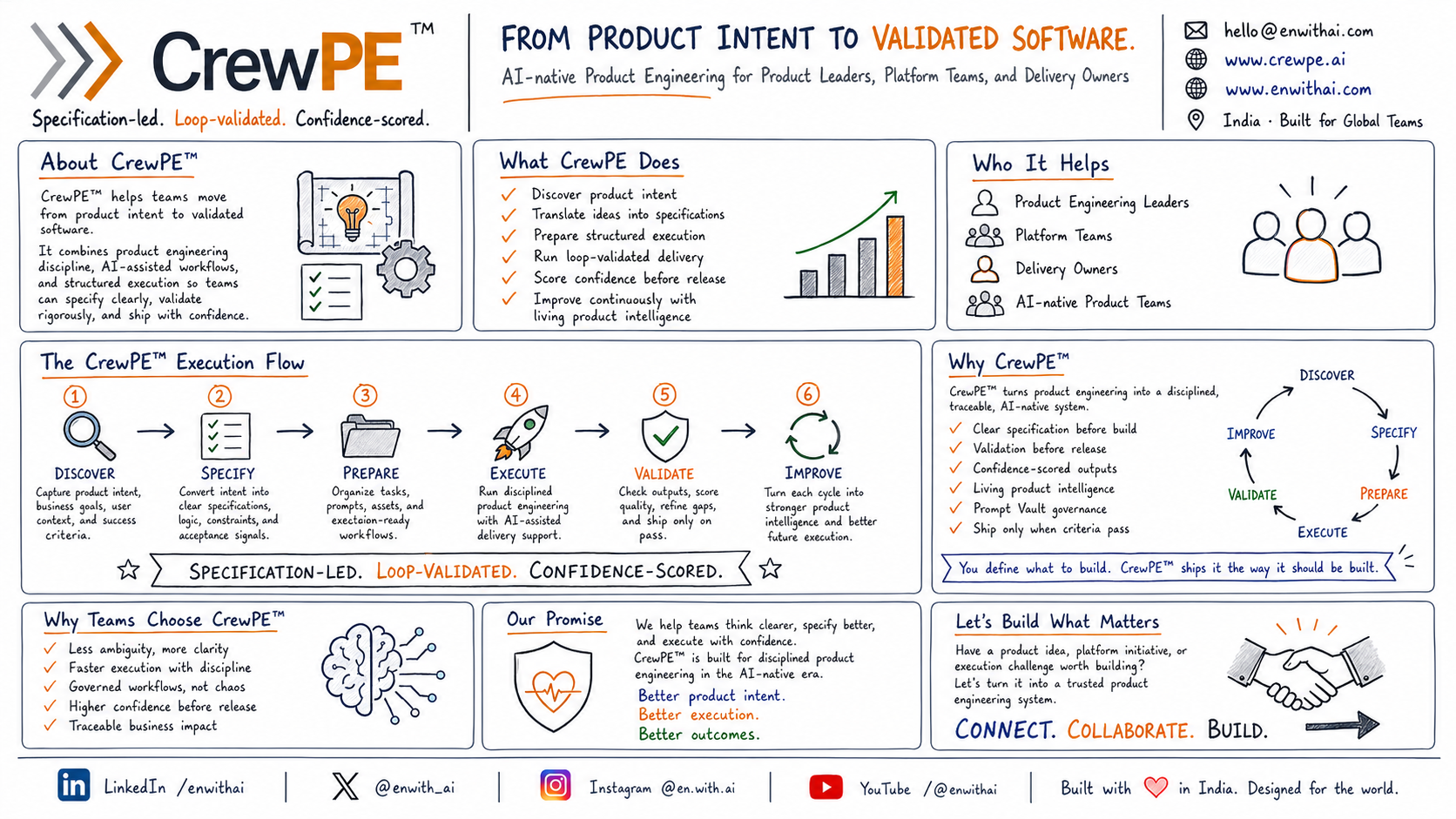
AI coding does not remove the need for SDLC discipline. It makes that discipline more important. When teams can generate code faster than they can clarify intent, validate quality, control cost, or trace business impact, speed becomes a liability. CrewPE exists to give product and engineering teams a guided path from product intent to validated software while still allowing the power of autonomous and AI-assisted coding.
The real issue
The constraint in software delivery is shifting.
For years, teams treated engineering capacity as the bottleneck. More developers, better tooling, clearer backlogs, stronger DevOps practices, and improved platform engineering were expected to increase output. AI-powered coding changes the shape of that constraint. Code generation can now accelerate dramatically. A product idea can become a prototype in hours. A backlog item can become a pull request with less manual effort. An engineer can use agents to explore codebases, propose changes, refactor modules, write tests, and generate documentation.
That is useful. It is also dangerous when unmanaged.
The enterprise problem is no longer only whether software can be produced. It is whether the right software is being produced, for the right reason, against the right specification, with the right controls, at a cost and risk level the business understands.
AI does not eliminate ambiguity. It can multiply it. Poorly framed product intent becomes poorly directed automation. Weak acceptance criteria become confident but misaligned code. Unclear architecture becomes faster fragmentation. Loose governance becomes hidden operational exposure. Cost models that were built for seats and sprints begin to break when token consumption, agent activity, retries, context loading, and validation loops scale across teams.
This is why CrewPE exists.
Why the usual approach falls short
The usual approach to AI coding is tool-led. A team adopts a coding assistant, gives access to engineers, encourages experimentation, and measures activity. Usage rises. Demos improve. Code volume increases. Leaders see momentum.
But activity is not delivery.
AI-generated code still has to satisfy product intent. It must fit the architecture. It must pass security, privacy, reliability, and maintainability expectations. It must be reviewed, tested, deployed, supported, and improved. It must not create more downstream work than it saves upstream.
Many teams discover this late. The AI tool performs well, but the delivery system around it is underdefined. Product intent is not specified sharply enough. Acceptance signals are inconsistent. Validation happens after the system has already created rework. Engineers spend time correcting generated output. Reviewers face larger diffs. Platform teams deal with inconsistent patterns. Cost owners cannot explain why AI spend is rising. Business stakeholders cannot see whether the spend improved outcomes.
The failure is not that AI coding is weak. The failure is that the SDLC was not redesigned for AI-native execution.
What leaders should pay attention to
CrewPE is built around a simple but important shift: do not start with code generation. Start with product intent.
The CrewPE flow makes this explicit.
Discover captures product intent, business goals, user context, and success criteria. Specify converts that intent into clear specifications, logic, constraints, and acceptance signals. Prepare organizes tasks, prompts, assets, and execution-ready workflows. Execute enables disciplined product engineering with AI-assisted delivery support. Validate checks outputs, scores quality, refines gaps, and ships only on pass. Improve turns each cycle into stronger product intelligence and better future execution.
This is not a slower way to build. It is a safer way to accelerate.
The reason is straightforward. Autonomous coding performs best when the work is bounded by clear intent, precise context, explicit criteria, and fast feedback. Without that structure, autonomy becomes expensive trial and error. With that structure, AI can be used aggressively without losing control.
Leaders should therefore stop asking only, “How much code can AI generate?” The better question is: “What product decision is being translated into software, and what evidence will prove that the output is ready?”
CrewPE exists to make that question operational.
The operating implication
AI-native SDLC needs a new control layer.
Traditional SDLC controls were designed around human task execution. AI-assisted engineering introduces new operating variables: prompt quality, context size, model choice, agent autonomy, retry loops, generated test coverage, hallucinated dependencies, hidden security exposure, and token-level cost. These variables do not fit neatly into conventional sprint boards or status reports.
CrewPE provides a guided execution layer between product intent and AI-powered implementation.
That layer matters because it protects both speed and judgment. It allows teams to use autonomous coding where it is useful, but within a loop that clarifies, prepares, validates, and learns. It does not ask teams to slow down AI. It asks them to direct AI through a disciplined product engineering system.
The phrase “specification-led, loop-validated, confidence-scored” is not a tagline. It is an operating principle.
Specification-led means the work begins with clear intent and acceptance logic, not vague prompts.
Loop-validated means the system expects iteration, scoring, correction, and improvement before release.
Confidence-scored means outputs are not treated as complete because they were generated; they are treated as complete only when evidence supports release.
This is how organizations preserve the power of AI coding without surrendering engineering accountability.
The NetworkGain view
NetworkGain’s view is that CrewPE exists because AI coding has created a new management problem: software teams can now generate faster than they can govern.
That gap will become one of the defining delivery risks of AI adoption.
The wrong response is to ban AI coding or restrict it to narrow experiments. That wastes capability and frustrates strong engineers. The equally wrong response is to let every team use autonomous tools without a guided SDLC. That creates uncontrolled cost, inconsistent quality, and fragmented product intelligence.
The better response is to make AI coding part of a disciplined execution system.
CrewPE is that system.
It gives product leaders a way to express intent clearly. It gives engineering teams a structured path to execute with AI support. It gives delivery owners a way to validate progress before release. It gives governance leaders a way to trace decisions, risks, and acceptance criteria. It gives organizations a way to build a learning loop from every product cycle.
This is especially important for product leaders, platform teams, delivery owners, and AI-native engineering teams. Their challenge is not whether AI can write code. Their challenge is whether the organization can convert product intent into validated software repeatedly, safely, and economically.
CrewPE exists for that operating reality.
What to do next
Teams should begin by applying CrewPE to a real product initiative, not an abstract AI experiment.
Choose a product change with meaningful business value, clear user impact, and enough complexity to test the method. Use the Discover stage to define intent, business goals, user context, risks, and success criteria. Use Specify to convert the idea into execution-ready requirements, constraints, test expectations, and acceptance signals. Use Prepare to assemble the prompts, assets, repositories, design references, dependencies, and review plan required for AI-assisted execution.
Then let AI help build.
This is important: CrewPE should not weaken autonomy. It should make autonomy safer. Engineers should still use AI assistants, coding agents, test generation, refactoring support, and documentation automation where they improve flow. The difference is that the work now runs inside a loop that knows what good means.
After execution, Validate should score the output against the original specification. The team should review not only whether the code works, but whether the AI process was efficient, whether rework was reduced, whether quality improved, and whether the token and tool cost made sense for the outcome achieved.
Improve should then capture reusable product intelligence: better prompts, clearer acceptance patterns, stronger test criteria, architectural lessons, common failure modes, and guidance for future cycles.
The goal is not to make AI coding look impressive. The goal is to make AI-native product engineering reliable.
CrewPE exists because the next advantage in software delivery will not come from generating more code. It will come from converting product intent into validated software with speed, discipline, and confidence.