AI adoption has entered a more demanding phase. The enterprise no longer needs more AI enthusiasm. It needs a disciplined way to turn AI intent into governed workflows, validated systems, measurable operating impact, and adoption that survives beyond the pilot.
The real issue
Most organizations are not short of AI ideas. They are short of AI execution discipline.
The pattern is familiar. A leadership team approves an AI initiative. A business team identifies a promising use case. A technical team builds a prototype. The early demonstration is convincing. Then the work slows down. Security questions emerge. Data readiness is uneven. Workflow ownership is unclear. Users do not change how they work. The cost model is not understood. The pilot produces interest, but not repeatable operating value.
This is the gap EnWithAI is designed to address.
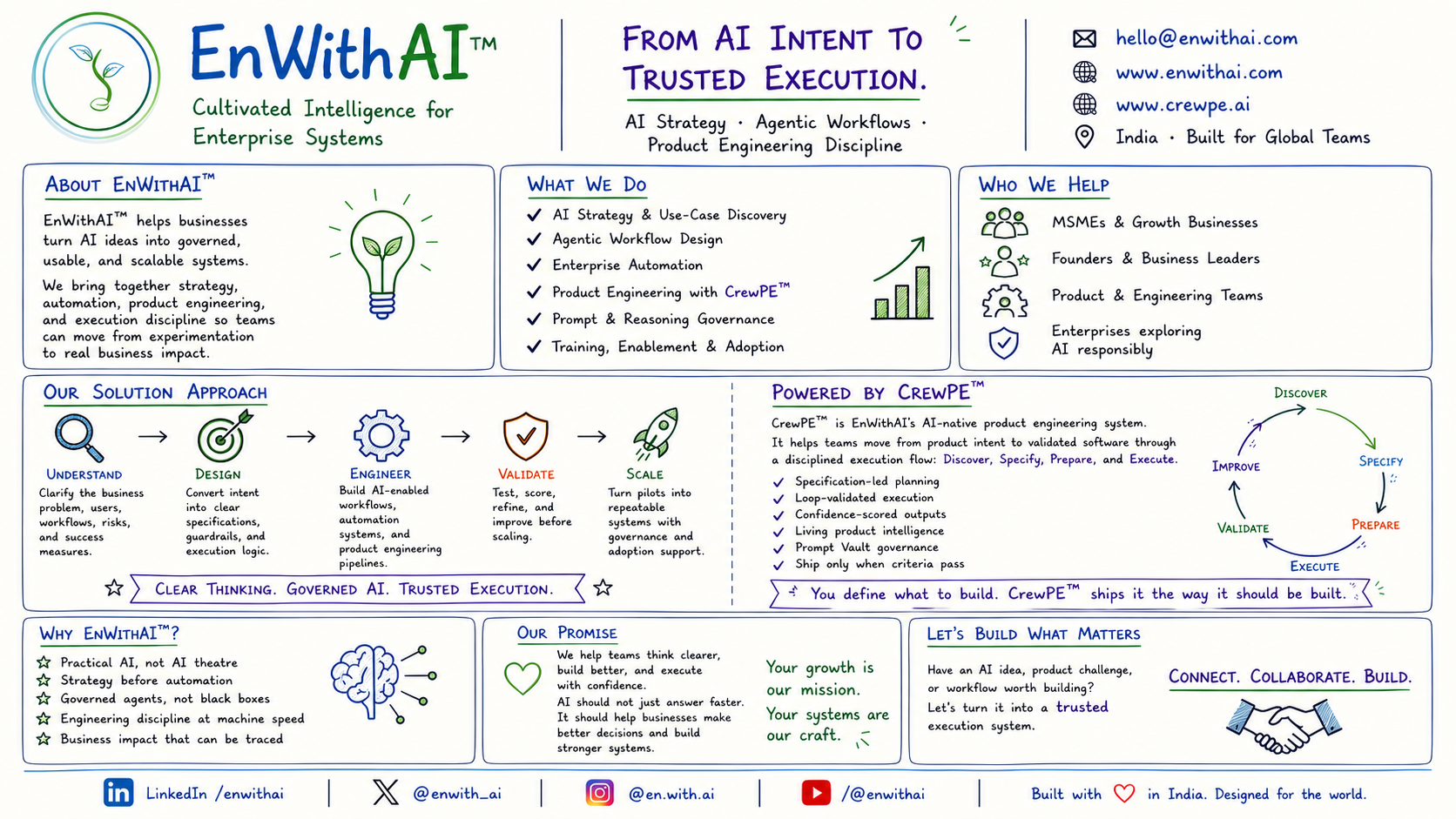
The EnWithAI visual makes an important point through its positioning: “From AI Intent to Trusted Execution.” That phrase matters. Intent is not the same as execution. A use case is not the same as an operating capability. A model is not the same as a business system. An agent is not the same as a governed workflow.
For enterprise leaders, this distinction is now central. AI must move from isolated experiments into the working fabric of the business. That requires strategy, architecture, workflow design, engineering discipline, validation, governance, training, and adoption.
Why the usual approach falls short
The usual approach to AI adoption begins with tools. Teams evaluate platforms, run proofs of concept, test copilots, and assemble demonstrations. This can be useful, but it does not create an enterprise AI capability by itself.
Tool-first adoption often misses five operating realities.
First, AI needs a business frame. Without a clear operating problem, AI activity becomes theatre. Teams produce demonstrations that impress stakeholders but do not change cycle time, quality, cost, decision speed, customer response, or revenue execution.
Second, AI needs workflow ownership. Agentic workflows cannot be designed in isolation from the people, decisions, handoffs, systems, approvals, and exceptions that define real work.
Third, AI needs engineering discipline. Production AI requires specifications, test criteria, release discipline, integration choices, monitoring, and rollback paths. It cannot rely on experimentation energy alone.
Fourth, AI needs governance at the point of use. Prompt and reasoning governance, data access, security controls, confidence thresholds, human review, and auditability must be built into the execution model, not added after deployment.
Fifth, AI needs adoption support. The value of AI appears only when people change how decisions are made and how work gets executed.
This is why the EnWithAI framing is timely. It does not present AI as a spectacle. It presents AI as a governed execution system.
What leaders should pay attention to
Leaders should pay attention to the operating sequence in the EnWithAI image: Understand, Design, Engineer, Validate, and Scale.
This sequence is stronger than a conventional “identify use case, build pilot, deploy tool” model.
Understand means the work starts with the business problem, users, workflow, risk, and success measures. This prevents AI from being applied where the organization lacks intent or readiness.
Design means AI is translated into specifications, guardrails, and execution logic. This is where business ambiguity must be converted into operating clarity.
Engineer means the organization builds AI-enabled workflows, automation systems, and product engineering pipelines. This shifts the conversation from model capability to system reliability.
Validate means outputs are tested, scored, refined, and improved before scaling. In enterprise AI, confidence must be earned.
Scale means pilots are turned into repeatable systems with governance, support, adoption, and performance learning.
The same discipline appears in the CrewPE™ loop shown in the image: Discover, Specify, Prepare, Execute, Validate, and Improve. This matters because enterprise AI is not a one-time implementation. It is a continuous operating cycle.
The operating implication
The case for EnWithAI is strongest where organizations face three pressures at once: AI ambition, execution fragmentation, and governance exposure.
AI ambition is already present in most leadership teams. Boards are asking where AI will improve productivity, reduce cost, improve customer responsiveness, strengthen decision quality, or create new capacity.
Execution fragmentation is also common. Business teams, technology teams, data teams, vendors, and functional leaders often pursue AI from different starting points. The result is duplicated experimentation, uneven architecture, unclear ownership, and weak value tracking.
Governance exposure grows as AI becomes embedded in decisions and workflows. Once AI moves into operational systems, leaders must answer more serious questions: Who owns the output? What data was used? What is the confidence threshold? What happens when the output is wrong? How is risk reviewed? How does the organization know the system is improving?
EnWithAI is relevant now because the market has moved from AI curiosity to AI accountability.
Enterprises need a partner and operating method that can connect AI strategy, agentic workflow design, product engineering, governance, training, and adoption. The EnWithAI promise — “We help teams think clearer, build better, and execute with confidence” — is credible when it is anchored in this discipline.
The NetworkGain view
NetworkGain’s view is that EnWithAI should be positioned as an execution bridge between AI ambition and enterprise reliability.
The value is not simply in helping teams adopt AI. Many firms can run ideation workshops, build prototypes, or recommend tools. The stronger value is helping organizations convert AI intent into governed business systems that work in production.
That requires an integrated posture.
Strategy before automation. Clear use cases before agents. Workflow design before product build. Specifications before execution. Validation before scaling. Governance before exposure. Adoption before declaring success.
This is why EnWithAI now.
The enterprise AI conversation has matured. Leaders are no longer satisfied with experiments that cannot scale, chat interfaces that do not change work, or automation claims that cannot be traced to business value. They need execution discipline.
EnWithAI’s strength is the combination of practical AI strategy, agentic workflow design, enterprise automation, product engineering with CrewPE™, prompt and reasoning governance, and enablement. This combination speaks to the actual barrier in the enterprise: not the lack of AI capability, but the lack of a trusted path from intent to implementation.
What to do next
Leaders considering EnWithAI should start with a focused execution assessment.
The first question is not “Which AI tool should we use?” The first question is “Which business workflow is ready for AI-enabled redesign, and what outcome would make the effort worth scaling?”
From there, leaders should identify three to five candidate workflows where AI can improve decision speed, throughput, quality, cost, compliance, or customer response. Each candidate should be evaluated for data readiness, risk exposure, operational ownership, technology integration, and adoption complexity.
The next step is to select one workflow and apply the EnWithAI operating sequence: Understand, Design, Engineer, Validate, Scale. This creates a controlled path from opportunity to production learning.
The final step is to institutionalize the learning. Every validated AI workflow should improve the organization’s pattern library, governance rules, reusable components, adoption playbooks, and product engineering discipline.
EnWithAI matters now because enterprises do not need more AI noise. They need trusted execution.
AI will reward organizations that can convert intent into systems. EnWithAI is built for that moment.